page 2
Wednesday
August 19th, 2009
Christ’s devil (2080
words)
In the original Christian universe, the one where the starry skies
whirled around the world, Paradise was above the clouds just out of
man’s reach, and Hell in the unspeakable depths beneath
his feet; there was but one God and his only interest and
affection was fixated on a flat piece of earth filled with innately
important humans surrounded by all the plants and animals placed
at their disposal—to serve as fuel for the divine purpose of human
imperialistic expansionism.
In Islamic tradition Lucifer (Iblis- إبليس) is a fallen angel (jinn)
the same as in the Christian texts but he is exiled from heaven for
disobeying Allah by refusing to bow before Adam though he would before
his creator.
In the Christian tradition Lucifer is one
of more fallen angels whose unforgivable sin (unforgivable because an
angel doesn’t need faith: he has knowledge instead) of
arrogating to a power equal to his creator’s, the
creator: God his father’s, without whom nothing but,
presumably, He, would exist.
-
How art thou fallen from heaven
O day-star, son of the morning!
How art thou cast down to the ground,
That didst cast lots over the nations!
-
“…you have come
to a dreadful end and shall be no more forever”
And unlike the Muslim belief, it happened
in the morally pristine spheres that were the world before the
introduction of the apple of God’s eye: humanity.
Since the Gnostics, the beginnings of Christianity and the
Catholic Church, there have been theologians as wise as philosophers* who have added complex moral
symbolism, interpretation or apologia for, or to, the stories.
Lucifer is symbolised by Venus his name meaning: ‘the light
of the morning’ or ‘the light bearer’,
like Apollo before him, he who was brought low by the capital sin of superbia
or conceit. He began his career after the fall not as God’s
nemesis, his moral inverse or competitor for the souls of men, but
rather as his agent, he who looked for evil and reported it to an
omnipotent and omniscient but apparently, distracted, God.
But Lucifer’s legend grew and evolved, and
artists who found him more interesting or priests who converted from
convincing man to follow the Christian creed through a desire for
God’s love to the more effective gambit of scaring the piss
out of them with the devil’s wrath, aided his fleshing-out
and filling-in until he became the alternate king reigning over
the other side of the axis of power.
Popes, monks, folkloric tradition, painters and poets worked over
centuries to bring Lucifer’s character to life, during the
low Renaissance Dante adds lovely poetic flourishes with the image of a
devil that reigns over the nine circles of Hell, himself stuck in the
lowest, trapped by ice waist high. He flaps his great black wings in an
eternal attempt to rise while the cold wind generated by those same
wings freeze the waters that hold him.
Or Milton a few centuries later who continues moulding
Lucifer’s image in his books really intended to address the
question of why an omnipotent God would allow evil within his creation.
The conflict between His divine and eternal foresight and
man’s free will. A benevolent and omnipotent God could
simply disallow evil in his universe if he cared to, if he does not,
does that not make him evil also? And if he cannot, then is he worthy
of adoration?
The Christian God therefore becomes an infinitely informed chess player
who stands for moral righteousness and rewards it with eternal
bliss and understanding, while his opponent (with the black
pieces) tempts man’s faith in goodness by offering immediate,
if short-term, delights. From the Qur’an:
-
He said: Then go down hence! It is
not for thee to show pride here, so go forth! Lo! Thou art of those
degraded.
Lucifer said: Now, because Thou hast sent me astray, verily I shall
lurk in ambush for them on Thy Right Path.
Then I shall come upon them from before them and from behind them and
from their right hands and from their left hands, and Thou wilt not
find them beholden unto Thee.
He said: Go forth from hence, degraded, banished. As for such of them
as follow thee, surely I will fill hell with all of you
‘I’, says the creator
in the last line, “-will fill Hell with all of
you”. Satan can convince God to punish man for taking his
(Lucifer’s) counsel but hasn’t the power to harm
man himself in any way but through moral influence. It is the loving
and forgiving father who decides to renounce his chess pieces
according to their fealty to his tenets—the rules for deserving his
love. He might also sacrifice a pawn to a side-bet with Satan as he did
in the sad case of Job, and sometimes, in his ire at losing the
contest, he might simply wipe the board of all its pieces until his
temper calms.
Lucifer yearns for the heavens and God’s, his
father’s, love, but is relegated to darkness and
immoral suggestion not because he is himself immoral but as an
expression of his resentment toward a father who doesn’t
recognize his son’s value, who doesn’t hold him in
a regard equivalent in degree to his own self-esteem. He tries to prove
his worth by showing he has an equal power over men. Lucifer says to
God that he will distract man from “…Thy right
path” because “…Thou hast sent me
astray”, he doesn’t disagree with God, he is merely
at war with Him because they both want the same thing: the power of
decision.
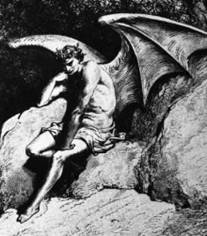 He must have been the most dashing, charming
and impetuous of all God’s sons whether they be
Christian angels or Muslim jinni.
He must have been the most dashing, charming
and impetuous of all God’s sons whether they be
Christian angels or Muslim jinni.
Lucifer wreaks evil, contention, conflict, cruelty, jealousy and
covetousness, using as entry his own sin as reflected in man: a
weakened will due to conceit. He cannot just walk up to men and
ask: “Would you like fifty years of unobstructed earthly
pleasures in exchange of an eternity of cruel torture in the fires of
Hell?” but he can whisper to
man’s vanity that he deserves more beautiful women or more
power over other men and if his innuendo is so tantalising that
the man succumbs to their allure to the point he suspends his ability
to calculate risk; and as consequence he persuades himself of the
rightness of a wrong and commits a moral crime, he tacitly
relinquishes his faith in God in order to do so—thus earning His
chastisement. It is neither man’s soul nor a pleasure in its
punishment that attracts the devil but rather his need to prove himself
to his father.
If Freud was right about anything he couldn’t have been more
right than in his concept of the Oedipal complex: we all know God, we
know he will never accept his son’s view of things, will
never let him sit to his right, will always expect him to bow before
him.
Among men the need to better one’s father, the challenge of
graduating to his strength, is either reached or not- it seems to me
that unless Lucifer repents with sincere contrition and asks His
pardon, God and he are locked in a battle that must end in
victory for one only, and perhaps even in the death of the other.
Tempting men with sweets that make them forget their teeth will fall
out if they eat them, must be easy enough, but still, there must also
be many who hold out through the vale of tears for the big dessert at
the end…
If I were Lucifer, filled by a sense of
righteous antagonism toward the injustice my father showed me, I would
probably learn to disguise the real import of my tempting suggestions
to try to fool those rational, or perhaps just dispassionate enough, to
resist being lured by the short money. I would imitate my enemy in
appearance; I would not entice to evil but represent evil as good. It
is clearly easy to make a good man kill by telling him it is good to
kill bad men, after that it is only a question of defining 'bad men'.
In fact it takes little more effort than a children’s
textbook like Der Giftpilz, to turn fellow men
into creatures foreign and odious to the species that reads it:
‘The boy goes on. "One can also recognize a Jew by
his lips. His lips are usually puffy. The lower lip often protrudes.
The eyes are different too. The eyelids are mostly thicker and more
fleshy than ours. The Jewish look is wary and piercing. One can tell
from his eyes that he is a deceitful person."
"Jews are usually small to mid-sized. They have short legs. Their arms
are often very short too. Many Jews are bow-legged and flat-footed.
They often have a low, slanting forehead, a receding forehead. Many
criminals have such a receding forehead. The Jews are criminals too.
Their hair is usually dark and often curly like a Negro's. Their ears
are very large, and they look like the handles of a coffee
cup."’
"From a Jew's face
The wicked Devil speaks to us,
The Devil who, in every country,
Is known as an evil plague.
Would we from the Jew be free,
Again be cheerful and happy,
Then must youth fight with us
To get rid of the Jewish Devil."’
Few among us today would fault the man who kills to save his own life
in self-defence, nor the life of another for that matter. But up until
recently certain European countries as well as the United States,
routinely pardoned such murders as the crime passionnél,
it being understood that when a good, God-fearing, Christian
man’s honour had been so far trespassed as his wife taking a
lover it was only natural he kill him and/or her.
In the cannibal tribes of the south
Pacific eating people was not exercised as a form of nutrition but
rather as a ritual of their religion. The boy couldn't become a man
until he had ingested his enemy's spirit through his flesh. What, you
ask, of the one eaten? He is added to the family altar to be remembered
as an honourable and valiant warrior who died fighting. According
to Judeo-Christian beliefs this behaviour is unmitigatedly
reprehensible but one can see, without needing to agree, that in the
cannibal's paradigm it is anything but evil.
It only took a blink of an eye after the
second world war to change a nation’s grateful camaraderie
with their Russian allies to fear, loathing and a finger on the
big red button. Normal, law-abiding, ordinary, family men have been
caught up in their country’s racial, economic or political
genocides (i.e. mass murders) all over the world and throughout
history. We little chess pieces really have no way of judging who sits
on which side of the great board and are most likely to believe
the one winning the game is the good one.
What if Lucifer won long ago? What if it is he who rules the heavens
and God who is shackled in a dank basement? The ruse maintained,
for fear of our rebellion. If he used this tactic it could mean that
the ten commandments with its amendments and addenda (allowing,
for instance, the militant Holy Roman Empire, the robbing of weaker
cultures for the greater glory of God, or even the saving of souls
under the threat of death) are precisely what win us an age suffering
the tortures of the damned… maybe turning the other cheek is
in fact evil and ‘an eye for an eye’
(especially if you take yours first) is actually good, it is only one
man's word, or strength, against the next which decides.
* What is a theologian, after
all, if not a philosopher with restricted access down certain avenues?
A theologian must rationalise forgone conclusion, a priori
premises, while a philosopher is at liberty to follow reason unfettered
to truth. Return
disclaimer: none of the above reflects my own
opinions, I don't base my beliefs on theological questions, I just find
them and their conundrums or paradoxes, interesting to consider.
Saturday
August 15th, 2009
Timelines
(100 words)
I read something I think was interesting
in a commentary about a life-long correspondence between two authors
who hardly ever met in person.
It talked of how an artist has two timelines, two histories, one led
and marked by his experience while the other, by his artistic
evolution. And it remarked how the histories may or may not
coincide; a high point of the creative evolution might cross a low
personal point and vice-a-versa or, indeed, any other combination
of possibilities.
Although it seems a little obvious now that I’ve read it, the
truth is I had never thought about it quite that way.
Monday
August 10th, 2009
Life's funnel
(540 words)
I was talking to my old friend Joe about
life and death. We talked of those who belong to our group: those
of the age for hindsight. I mentioned how many I knew who regretted
their choices, even some who I knew when they embarked,
enthusiastically, on the road that has disappointed. Of others who seem
lost, who gave their lives to their families and at fifty wonder
who they are aside from fathers, husbands or workers. And even those
who are disenchanted without realising they are disappointed, those who
live unexamined lives.
When I asked him how he felt about the shortening funnel of life he
thought I meant it as a metaphor for time (which is more like a
snowball rolling down a snowy mountainside!) but the image of a funnel
comes to me in terms of experience.
Nearing fifty I think of the large amount and wide range of
sometimes indiscriminate experience that lies behind, and how in
forming me it also made a better judge of me; hence the funnelling
which, with a narrowing of options also provides greater
distillation—the decreasing breadth of choice, becomes augmented
focus. And with age
comes a cumulative power drawn from understanding one’s self,
one’s abilities, one’s failings.
Joe, who is a successful scientist, summed up his feelings about his
life thus:
"Good luck kept me legal and alive. Good fortune led to my present
career. The sweet angels brought me my wife. My contribution
has been a sufficiently creative intellect to be valued as a
contributor among more staid thinkers. I never wanted to "work hard"
and I've succeeded. I've never "tolerated authority" and I
have none over me. I always cherished the feeling of getting away with
something - whether skipping school, church or work. That liberating
sensation of being free, unaccountable, and somehow special has endured
from a young age."
Joe and I have known each other most of our adult lives and
have often commented on how different our roads are just as we have
each observed in the other, where the road not taken leads. For myself,
despite the big errors, the bad decisions, the harm I’ve
caused, the events and consequences that show themselves poor in
retrospect, the ones I might pluck from my past given the power to do
so, I am satisfied by who I am and confident all tomorrows will
be stupendous just as I cherish the memories of my
past good and bad together. I know it takes mistakes to
‘become’.
A man cannot be truly honest until he has
stolen and regretted it. And I realize I wouldn’t
really change a thing about my past, about the person who committed
those mistakes, nor would I exchange my future for another’s.
The better judge I have become, the one who might change certain
moments of the past if he could, wouldn't exist if he did.
I've been reading thoughts about death by minds remembered for
thinking about such things and after life Joe and I talked
of death, and I thought his comment was really rather good in
comparison: "I know I am mortal and my life will end, but not today,
and not tomorrow either..."
Friday
August 7th, 2009
Souvenirs
(630 words)
I love to walk. And so, where many like beaches, I like mountains. On a
beach everything is always the same, every sunset or sunrise (depending
which side you’re on) is routinely beautiful; while in the
mountains every hundred paces, up, down or across, is new, and
every sunset or sunrise (or both if you climb to the top) is a surprise.
I walked in my mountains today, as I do every day, with my dog: Egon,
just as we did at five o’clock this morning under the full
moon when every shadow is an uncompromised ink spill and the
silent owls appear suddenly, great flying darknesses swooping too close
to one’s head.
They are not the most beautiful mountains I have known or lived amid,
but they are admirable in their own distinctive way the way mountains
always are, whether they be the breathtaking Rockies or Alps or
Himalayas or the rich, romance-laden Khyber range; salt and sand
shorn of all living things but goats, hawks and bandits. The
mountains I live among now are as much African as European, being as
they are, closer across the water to Morocco’s Riff mountains
than to Sevilla, the nearest city. If the mediterenean didn't have to
empty through this funnel, the channel would be no more than a pass
between mountains.
I often find souvenirs on my walks, a small animal skull, washed
and bleached; a fossilized seashell, 300 meters altitude, sixty
kilometers distance and fifty-five million years out of its
depth. Sometimes I find an idea for a painting or something I want to
write—I think best when I walk—and sometimes, I find no more
than a new memory I might recall sometime in the future.
Once it was a chameleon, that most charming of lizards, as big as my
extended hand without his tail. He thought he could fool me by moving forward and
back at every step, imitating the random movement of grass blown by the
wind instead of the linear movement of escaping prey; unfortunately he
was on clear, sandy ground and despite his subtle subterfuge
and sand-coloured camouflage, I could see his shadow as sharp as
cut paper.
As I moved toward him he gave up the drunken stagger and broke
into a full run whose speed turned out somewhat underwhelming compared
to my own. I snatched him up and looked at him and he at
me, his ice-cream-cone eyes moving in all directions at once as he
tried to take in the creature that now not only held him high above the
ground but also surrounded him. He opened his mouth wide showing me
past his small, sharp, serrated jawbone and deep into his body as
he tried desperately to bite me and I wondered: if I were
abruptly scooped up by the trunk of an elephant, would I have the
courage to punch him?
But we made it to the other side of the barren earth despite his threats,
where I let him go among the bushes lest he be picked up as falcon-food
before he could make it across alone with his ridiculous  swaying walk.
Today it was six black vultures who caught my eye, sitting heavily in the upper branches
of an old, dead Walnut, one more circling above: an animal was dying
nearby. Beneath them an Egret followed a brave bull who grazed
unconcernedly but would, one day, die on the sword of a brave Matador.
The Egret showed no impatience for the food he finds in the earth
overturned by the bull, but walked beside him more than following him,
quietly
considering his last remark—his hands behind his back as if
courtesy
demanded no less than joining the bull in his lazy perambulations.
Thursday August 6th, 2009
 Moon
Myths (580 words) Moon
Myths (580 words)
"Man is a credulous
animal, and must believe something; in the absence of good
grounds for belief, he will be satisfied with bad ones"
Bertrand Russell
We humans want so badly to know, to understand, to have definitive
truths, that we are ready to ignore absence of reasonable criteria or
lack of method, to jump to conclusions based on intuition,
sub-conscious impulses, hearsay and unexamined argument rather
than having to say: "I don't know." or: "It is merely coincidence."
It is thus, I think, that one hears so much superstitious belief
attributed to our moon’s influence by otherwise
discriminatingly intelligent people, like: More strange behaviour
manifests during a full moon than a waxing or waning one. If the moon
controls tides why shouldn't it be true that it has an effect on us
too? We, like our planet, are made mostly of water, after all.
One of the reasons people
think there is more unusual behaviour during a full moon is because
they don't distinguish clearly between a full moon and as many as
three days to its either side, making the chances of their believing
something occurred during a full moon, not one in thirty but one in
five.
When one sees strange behaviour
and thinks to look to the moon but finds it is not full, he
forgets the illogical connection while every time it is, he remembers
it, making it common that each one of us might remember something
bizarre we witnessed during full moon.
During a full moon there is more
light. Up until the recent invention of well-lit urban centres
the nights around full moon were the most attractive to venture out in.
Nights that are more populated also offer proportionately more
possibilities of aberrant behaviour being witnessed by others.
The moon's mass is one eightieth
that of the earth's and it spins around us at a mean distance of
38,000 kilometres in a circular (not eliptical) orbit. The tides are
caused by the moon pulling the oceans
from one side of the planet to the other through the effect its gravity
has on the world's own as the moon circles in its orbit. But the effect
the moon's gravity has on the world belongs to the physical
relationship between earth and moon, while the amount of light
the moon reflects, or conversely: the amount of shadow the earth throws
on the moon, is a function of the angle between the moon and sun
relative to the position of the earth—which has no import whatever on
its gravitational pull; i.e. just because we can't see the side of the
moon in shadow doesn't mean
it is not there.
Besides, the fact we are mostly
made up of water means that among the great variety of cells that make
up our bodies, on average, each is a little sac containing 60% water
with elements like the cell's nucleus, organelles and
mitochondria that swim about in the fluid carrying chemical information
to and from the cell's limits and it's nucleus. They can
only
move around or remain suspended because in a sub-cellular landscape
gravity holds no sway. If it weren't so, all the mobile parts of a cell
would simply lie at the bottoms of their little sacs of water making
life impossible (literally).
In other words: as we stand on
the earth's crust with ten kilometres of atmosphere held above us, the
planet's entire cumulative gravitational force cannot reach inside one
of our cells, nor could it bring an ant to crash under its own body
weight if it tried to commit suicide by jumping from the tallest
skyscraper, do you suppose the moon's could?
|
Wednesday
July 29th, 2009
神道 Shin tao
(The Way of the Gods) has roots
that go back to 500BC though it wasn’t formalised as Shinto,
both a path to wisdom and quasi-religion, until the 6th century
AD as an amalgam of incorporated harvest and clan traditions.
A typical Japanese might register or celebrate a birth at a Shinto
shrine, while making funeral arrangements according to the Buddhist
tradition. Unlike many religions, Shinto and Buddhism do not require
professing faith to practice, being centered more in ritual and
respect for the living spirit of each thing.
How chaos was subdued in the Japanese genesis myth
(680 words)
In the eighth generation the primitive
gods brought forth Izanagi, the inviting male and Izanami, the
inviting female (Izanagi-no-mikoto and Izanami-no-mikoto).
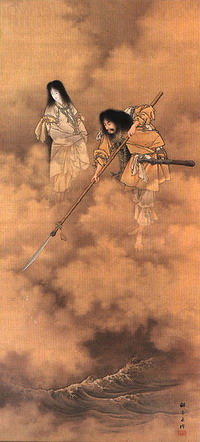
They lived in a great nothingness without height nor breadth nor depth;
without light or darkness, without colour or its lack.
Together they thrust their jewel-encrusted lance into the chaos which
was like a fertilized egg; as they stirred, its viscousness thickened,
and when they pulled the spear out, the last drops that fell from
its tip formed the islands of Japan onto which Izanagi, the inviting
male and Izanami, the inviting female, descended to erect the august
celestial pillar.
And Izanagi asked Izanami: How was thy body made? “It grew
everywhere except in one spot, and thine?” to which
Izanagi, the inviting male, answered: Mine, like thine, grew
everywhere, but more especially at one spot. “Were it not
good to place that part of my body which is in excess into that part of
your body in deficit?”
They decided to go ‘round the celestial pillar in opposite
directions. The female went left while the male went right and
when they met, she said: “What a beautiful and charming
young man!” to which he answered: “What a lovely
and loveable young woman!”
The woman showed willingness but it was the movement of a Wagtail that
impelled him forward. Izanami thus bore many divinities; light, rocks
and mountains, the breeze and stillness, the oceans
and their waves, plants, animals and subterranean grottoes.
Each, the rock or breeze as much as any animal or plant, with its Kami:
its spirit and its self-ness.
When Izanami gave birth to fire, however, she did not survive it.
Izanagi, the inviting male of  exalted and fruitful love, in a torment
of despair and stricken by grief, lay prostrate at the foot of
her bed and wept for his beautiful young sister.
exalted and fruitful love, in a torment
of despair and stricken by grief, lay prostrate at the foot of
her bed and wept for his beautiful young sister.
Thus he came to know his sorrow and his ire and he vowed to
rescue his wife from the underworld and bring her back to him,
but not before he killed he who had killed his love. But the fire God
not only would not be defeated but raged at every blow throwing off new
divinities right and left.
Izanagi gave up his struggle and went to find Izanami while
behind him one of the gods created during the battle, the impetuous
male, wreaked confusion and returned the celestial
world to chaos. In his impetuosity he broke the dykes of the rice
fields, attacked the palace and threw the stinking carcass of a
dead horse onto its rooftop. He left Amaterasu’s spinning
and weaving girls hurting in their most intimate parts and
even chased the Goddess who makes the sky resplendent, that is, the
sun, into seclusion thus turning the world dark and leaving it in
a desolation filled by terror.
Izanagi finds Izanami in the underworld as a rotting corpse and
she chases him away ashamed to have lost her beauty.
The gods come together to think up a
stratagem to control the impetuous male and his anarchistic
influence, finally tricking him into a cave and closing its
opening once he was inside. He could not escape back into the celestial
world but could drop down onto the earthly paradise of the eight
Japanese islands where he was both brutal and heroic. He killed a
terrible dragon that ate virgins and he bore a son who fought the
jealous gods and is remembered as a lover of undaunted passion.
Friday
July 24th, 2009
Noah Lukeman and the murky world of today’s book
publishing (760 words)
Noah Lukeman is president and founder of Lukeman Literary agency
in New York city; an agency that get books into print and on
bookstore shelves by offering them successfully to publishers who, in
turn, no longer deal with contract-less authors directly.
Making his agent’s fees, which easily account for greater
earnings than any single writer on his list, however, was not enough
for Mr Lukeman. Five or six years ago he broke into authorship himself
with a book titled How to Write a Great Query letter
with which he began making money from desperate writers who he would
not represent and whose writing he would not read, apart from,
and in addition to, the ones he does.
The downloadable pdf document with few words on few pages reached
best-seller status, so desperately optimistic are authors in this
shrinking printed book market. But despite recognising the exquisite
irony of a literary agent with no literary pretensions in his
literature, becoming a successful author by selling an instruction book
to would-be writers which teaches them how to talk to him, I bought it.
Although the pages my 25 bucks got me permission to print held no
secrets I could not find for free from multiple sources on the Internet
(like his less money-hungry competition or long lists of successfully
published writers who offer advice because they all remember their own
decade of rejections) it was at least concise and all in one
place- I did not regret buying it and it probably did indeed
improve my query letters.
I just received an e-mail from the Lukeman agency advising us writers
that in an impulse to give back to the writing community he has decided
to now (since May 2007) offer the same book for free but has in the
meantime, written another bestseller for the same market slice: writers
who want to find agents; and he also offers the wisdom of his
advice (i.e. telling writers which are the rules dictated by him
and his peers) on his Web-site whose link I clicked on.
It turns out it is no more than an offer to allow you to read his
comments in his own Site’s forum for a fee of twenty dollars
a month. Not a big investment which might even offer a pay-off for some
writers and yet, the leeching quality of his breaking into an
income stream generated from the very people he is meant to represent
is disheartening on principle, just as paintings galleries that rent
wall-space per square metre are: both are meant to glean their earnings
as middle-men from a sale transaction they themselves arrange for a
buying public, not directly from the creators of the product in
exchange of slim help in reaching a middle-man he, the middle-man,
offers.
His agency has a slush pile of so many manuscripts that they are not
accepting query letters and I wonder where, in a world that has
abandoned the arts—that teaches the young that books are no more than
repositories of information instead of worlds of literature (faster to
find from Internet sources than the dismal task of actually having to
read books), where will the next generation find the motivations to
become artists of any kind? And where will the world end up when it
finishes forgetting how important the arts are to every culture?
One might conjecture that in a world with exploding population
there would be a proportionate increase in that always small percentage
whose taste is more exigent, who want superior quality, who want
luxuries like art with their information. In-fact the growing number of
spending public means it is a bad business decision to pander to the
discriminating when the larger percentage of the market, the clueless,
is also growing exponentially- as always, with volume comes loss of
excellence.
addendum:
Today I read an article about a certain Baroque painter from the
lowlands whose work the New York Times, whose proofreading is routinely
flawless, described as Caravagist; and I found myself wondering what
was wrong with the term traditional to sometime after Caravaggio's
death of Caravaggiesque? Must a Rubenesque nude also now become
Rubinist?
This same modern efficacy where shortening a word presumably
to save either the writer the physical task of having to hit four or
five extra keys, or the reader the mental task of having to orient his
mind around so very many symbols, that works as metaphor for the loss
of poetry in modern prose.
Monday
July 20th, 2009
Morality and religion (490
words)
I suppose there are still people who believe religion fortifies moral
infrastructure; here in Spain it wasn’t long ago that
children were allowed to opt-out of Catholic training though they still
pray in public schools daily.
At first they changed the class from religion, i.e. Catholicism; to the
comparative study of religions, although the only relativism taught was
how correct Christ’s teachings were when compared to all the
other, silly, religions. When Franco’s pall was finally
lifted after nearly 30 years of slow change and children really
had a choice about being indoctrinated with their ancestor’s
religious beliefs, they were then offered the choice between religious
study and ethics, as if without
the former they had no way to learn the latter.
As if without a fear of God, a fear for one’s own immortal
soul or the threat of some kind of retributive punishment after death,
we would just throw our hands up and say: “Well, since
it doesn’t matter anyway I might as well drink blood squeezed
from live babies!” In fact, in my experience, there are as
many good people and villains among the
demographics of theists as that of atheists.
Indeed, if we looked more closely at some widely agreed moral
infraction like say: paedophilia, I bet we would find that men forced
to celibacy for their religious practice are the more frequent
offenders.
So why don’t we, the unafraid of divine wrath, go on
rampaging binges of wildly sinful behaviour? In part, I think, it is no
more than the fact our basic biological motives: the altruism that
serves both society and the altruist, empathy that impels us to
feel the pain we inflict on others, or the sympathy to turn the tables
on ourselves when considering the personal advantage taking from
another would attain—seeing ourselves reflected in our potential
victim’s eye, is largely due to an innate socialising
instinct that stems not only from our need to live in collaborative
fashion with others of our species but even more, just like dogs, we
become confused in our own identities when out of contact with our
taxonomical peers.
There is also self-image which is attached implacably to the
self-esteem which suffers when our judgement, skewed by self-interest,
allows us to cross our own moral boundaries. To a Christian this poses
a lighter threat to his psychic well-being since once the pleasure is
lived and real contrition arrives, his loving God will forgive
him—it is a far more difficult thing to acquire one’s own
forgiveness and nothing, after all, is harder to live with than
remorse.
So apart from it simply not being true,
if religious beliefs are also neither consolation nor moral pillar, I
think the main reason left for clinging to an imaginary friend is the
value and verification of a caring witness to our existence, just
as a parent is for a child.
Saturday
July 18th, 2009
Music and Love
(280 words)
Some friends and I went to see Omar Faruk
play in the old Moorish gardens of Jerez under a crescent moon last
night. We, the audience, had the added luck to have Arto
Tunçboyaciyan join Faruk and his five-man band, adding
his talents and humour to the proceedings.
At one point Arto, the Turk, looked across the stage at I’m
not sure which, either the Greek keyboardist or the Israeli Jew on
guitar—perhaps both, and said: if we can
make music together all men should be able to get along; and
Faruk added: “What Sufism has taught me is that we
needn’t all love one another as long as we just respect each
other.”
And it made me think. Even I who was not grown in religious soil of any
kind and, I think, also most occidentals, know the Old
testament’s teaching about loving one another (Leviticus
19:18): “Thou shalt not avenge,
nor bear any grudge against the children of thy people, but thou shalt
love thy neighbour as thyself” is impossible to accomplish
among mere humans and yet I had never questioned that, as an
ideal, if we all loved each other as we do ourselves the world would be
much improved.
When I thought about it more deliberately however, I realized that not
only is our own capacity for real love limited to a small number of
subjects but that it would be anything but nice
to be loved by everyone else.
If we reached for less than love and just respected
each other as we do ourselves instead, it would not only be enough but
preferable.
Click
here
to hear something by Faruk
Friday
July 12th, 2009
Temeris Mortis (1090
words)
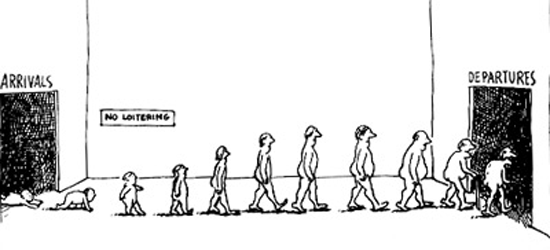
'Men, commonplace and
ordinary, do not seem to me fit for the tremendous fact of eternal life.
With their little passions, their little vices and virtues, they
are well enough suited in the workaday world; but immortality is much
too vast for beings cast on so small a scale'
SOMERSET MAUGHAM
As this collection of thoughts and
stories, which I call my Mental Workshop, grows
older—four years old a month ago—I see trends reveal themselves
that reflect my mood, or the reflections consequent to my reading
and conversations of the time. Periods of months together about
art, theology, science, or the eternal mysteries of relations between
the opposing genders of our species, (i.e. love). It is sometimes
light-hearted sometimes gloomy, sometimes proud, at others insecure:
and the collection of written reflections becomes in itself a
reflection for their author.
I have been reading Julian Barnes’ Nothing to be
Frightened of, yet another book by an old man writing about
death: “…fear of death irrational?”
Barnes asks, and answers himself: “Why, it is the most
rational thing in the world—how can reason not reasonably detest the
end of reason?”
Soothing reading I guess, as Montaigne believed: Since we cannot defeat
death, the best form of counter-attack is to have it constantly in mind
in order to make its abyss appear less formidable.
I am long familiar with Barnes’ shorter work which I have
always read with admiration for his dominion as word-smith but upon
reading my first book-length composition by him I realize he is so much
more, he is a master of the word and,
ultimately, that is where literature resides, in the word.
He describes being described by a literary critic with a coined word:
polyphiloprogenitor, because the critic said of him: “Barnes
is father to forty books and four children”.
An intriguing mind, don’t you agree?
The book gives him room to speak in what seems a breezy, spontaneous,
conversational tone while, in fact, he weaves a medley of ideas
and narrative in a complex web of self-reference.
Although I have yet to finish the book he has already provided me with
a rare insight into each’s own mortality, an original thought
added to the basket of old wisdoms and observations. He says all
of us non-old people imagine, naturally enough, our extinction as a
goodbye to life when in fact (for those lucky enough to reach
senescence) it is not a leave-taking from life but rather a goodbye to
old age.
It is heartening to realize that in a world newly turned away from the
wisdom of age, a world where the young know more relevant information
than the old who haven’t had time to assimilate or re-learn
an unusual century’s changes, there are still some things a
young man can’t know unless he is told by an old one.
Today I sat at a sidewalk café on a street of the ancient,
history-soaked, horse-trading town of Jerez de la Frontera while
waiting for a friend. As I idly people-watched I saw an encounter which
is common enough but with the difference that today I noticed it: two
young men who met accidentally in the street a few metres from my
table; close enough to watch but whose voices were drowned in city
noise. They fell into earnest conversation as if they really had
something to talk about instead of just exchanging polite noises:
dialogue instead of small talk. I was about to look away to see if my
eye fell on something more interesting when a woman walked past.
She was not a beautiful woman: middle-aged, thick-ankled and
generally unfit compared to the good-looking young men who talked to
each other. But she wore enough sexual symbols in her tight white dress
and pumps—in a place and climate where most women wear
flat, open sandals and light, loose clothing—that like a
baboon’s red and blue ass it drew the two
men’s sub-conscious through their eyes to watch her jiggling
gluteus maximus’, until they eventually disappeared from
view; the whole while maintaining their engagement in their
conversation with the conscious part of their minds.
And once again I had pause to consider how we primates are separated by
so very little from mere monkeys.
The conscious mind’s evolution has been so much faster than
the biology it stems from that it lies to each of us about a duality
which is a fiction in an attempt at social contract between the
fundamentally dissociative elements.
If my example of the men’s eyes
being drawn to a woman they would not be consciously interested in, is
an example of biology’s rule, and their conversation a
manifestation of the higher, conscious mind (the one we like to think
of with free will), then it follows that if I weren’t
convinced just as you are that we are each indeed two: me and my
mind, the witness and the subject, my mind and the brain it
watches dispassionately, I would be able to fuse the two into a simple
‘me’ thereby getting rid of the only one who finds
death abhorrent, the one who imagines himself its witness.
addendum:
When Mr Barnes indulges in a prophetic look at his own worst-case
demise he sees it as being: "...preceded by severe pain, fear, and
exasperation at the imprecise or euphemistic use of language [by those]
around me."
The last time I was in L.A. someone asked
me that quintessentially Californian question (from within my European
kinesphere): "But are you happy?" I thought a moment in an attempt to
answer such a complex but direct query with a direct answer but could
only think to say: "When I am alone I tend to simply serious..."
And so, in this New Age world where I seem
surrounded by those who dedicate themselves to achieving a state of
emotional complacency; devotedly escaping what they consider negative
emotions, if asked about the pseudo-debate between the relative values
of intellectualism and emotionionalism, I would have to answer as
I imagine Barnes might: In my beliefs I strive for rationalism while in
my behaviour I am slave to emotion. My puny mind (or should I say:
brain?) sees paradox where all around me see unity.
If it weren't for the doubt I harbour
about my own sanity pointing to the probability I am actually not
insane, then there really would be very little room for doubt at all;
but finding books like this one provide the grace that if I am, I am at
least in interesting company.
Friday
June 26th, 2009
The Dream
(110 words)
Last night I dreamt of a beautiful house I once lived in for a time. In
the dream I remembered its every detail, its every room and
shelf, and how it stood on a hillock hidden by carefully tended
gardens.
I asked myself who had loaned it to me,
because I remembered it hadn't been mine, but couldn’t
recall; I then ran a number of countries through my mind trying to
place its location but without success. Still without waking and
frustrated by the lacunas in my recollection, I realised the memory was
real but the house was not, what I remembered so vividly in my dream
was another dream.
Saturday
June 14th, 2009
Peace (1440
words)
I have a dear old friend who is Christian, his name is Bob. We usually
live in different countries though we met when we both lived in London
and later, we shared NYC. Since then our long friendship has been
kept alive by sporadic correspondence of great volubility spotted by
occasional meetings, one of which I enjoyed in the form of a recent
visit.
As always we discussed philosophy and theology while: I took him out
sightseeing, between mouthfuls of food and when we weren’t
occupied otherwise in general.
He once again brought up de Caussade, the
early-eighteenth century Jesuit priest, theologian and mystic who has
been a particular inspiration to Bob’s faith and moulder of
his attitudes toward life.
Bob’s description of de Caussade’s central thesis,
Abandonment to Divine Providence, goes something like this: Evil must
be part of a plan too complex for us to understand since a perfect God
could only create a perfect world. This reminded me immediately of
Candide and since Voltaire published Candide in 1759 I wondered if his
sarcasm wasn’t directed at de Caussade. When I looked it up I
found Voltaire was lambasting Leibnitz instead, the brilliant
Rationalist who nevertheless is remembered better by history in his
alter ego as Voltaire's Dr Pangloss. After each of the terrible
calamities that happen to Candide or which he witnesses, his tutor, Dr
Pangloss, reminds him: “All is for the best in the best of
all possible worlds"
Besides, it turns out de Caussade was so fearful of the Church
fathers’ possible charges of quietism that his writings
weren’t published until 110 years after his death and even
then in a version censored by a fellow Jesuit because of the
impossibility of escaping punishment under the totalitarian Catholic
regime otherwise. Meaning effectively, that he wasn’t
published unabridged until 1966, nearly a quarter of a millennium after
he wrote.
De Caussade’s less simplistic credo actually went more like
this: The present moment is a sacrament from God and self-abandonment
to it and its needs is a holy state. Which, in turn, sounded to me more
like a Buddhist derivate such as Bodhidharma’s Zen.
Although when I thought about it, I realised the similarity in
conclusion obfuscates the very different reasons for reaching similar
truths: De Caussade’s abandonment is, in fact, leagues from
Buddha’s detachment.
My thoughts then took me outside the set of theology and into
philosophy where I found memories of Epictetus, the Greek
slave-philosopher.
I have always had a soft spot for that great thinker trapped in a life
as muddy as Job’s. As a slave to a cruel master, anecdotes
abound, like the one where his master, Epaphroditus, amused himself by
twisting Epictetus’ leg. Because of his philosophy (it is
said) he was able to look on dispassionately, even warning his master
that if he continued thus he would soon break the leg and be
master of an incapacitated slave; and didn’t shout-out when
his master went on to break it.
Epictetus centred on his belief that suffering arises from trying to
control what is uncontrollable. The Buddhist-like detachment that
results from the discipline to accept the immutable, diverges from the
Buddha’s in that it strives ultimately for happiness.
When Epictetus advises: "Do not seek to bring things to pass in
accordance with your wishes, but wish for them as they are, and you
will find them" I think it is an
interesting philosophical considerations but self-defeating in
terms of getting what one can from the experience that is life.
I think a successful life, within
the context of ultimate purposelessness, is one that is noticed by the
one who lives it—one that has events important enough to the one
living them to make perduring and cherished memories; peace,
balance, equanimity, denial of passions all lead to the opposite:
negligence and lack of engagement.
Epictetus himself may well have found all
the reach of life’s possibilities within the small range
available to him—one that includes living the full 1 to 10 scale
where 5 is acceptance, 10 is joy and 1 is desperate
melancholy. But in-fact his life was a pathetic example of what it
might have been given the full gamut of possibilities you and I,
as our own masters, can hope for.
To me it is clearly a slave philosophy
formulated as a reaction to Epictetus’ circumstances when
compared to say: Socrates, who refused to live any way but that which
he considered correct even when faced with execution by the state.
Epictetus' acceptance, like Buddha’s detachment or de
Caussade’s abandonment, seem to me, more resignation than
peace.
Rather than being a
sophisticated attitude that aids the experience of life, the
resignation is one for which one must exchange the highs and lows
that make memories. Predictability is a poison that dries the sap of
experience and what could be more predictable than knowing
everything is okay simply because everything is always
okay?
Although Bob and I both realize our ongoing debate is futile in
the sense that we argue from different platforms which overlap but do
not coincide: theology and philosophy. But it is only futile if
our objective is to convince the other or change his point of view
because Bob’s lively mind inspires new considerations
and thoughts in mine regardless, and I hope the same is
true for him because it in itself, is a rare enough pleasure…
To my arguments that life is in an essential way, the accumulation of
its memories, Bob answered recently: “Memories may be
important to you, but to me they're not. At my age {65} I can't
remember a damn thing! Barbara {his 17 year old daughter}
sometimes says, 'do you remember when we did this?' But I
never have any memory of it.” I answered: “And thus
you prove my point: If you don't live for the production of memories
you will end in the sad condition of having none and wondering
what you did with your unique and
singular life.”
When I spent time in a Buddhist temple (as novice in
Thailand) I watched the monks in their daily life and
found them (to differing degrees) at peace if not spiritually, which is
difficult to decide through observation, at least in the quiet
acceptance of a perfectly predictable life—just as many feel in
prison—but as examples of 'life' I'd say that at their ends they will
have only made one memory of the entire experience instead of the
variety and depth of those who strive instead of accepting.
We toss words like ‘joy’ around easily, we
all know how it is defined in the dictionary and don’t
feel a need to describe our individual sense of it when talking with
someone else but in fact there is only a personal definition of joy; it
is equivalent to the highest experienced
happiness, not to a scale of the possible, i.e. if one has only ever
reached a 7 out of a possible 10 on the happiness scale it becomes
subjectively, the definition of joy. The 7 that thinks it is a 10 will
not have any way to know it has missed something until the day it
reaches 8.
When Bob, who has led an unorthodox life
largely dedicated to reading, writing and the search for truth,
talks of his self-doubt in his observations of the differences between
his life and those around him (he still lives in NYC) he uses the
metaphor of the piglet who built the house of bricks and says:
“…those who planned for their retirements—even
early retirements—seem to have some nice and recurrent highs, as
they have virtually no financial worries, travel all around the world,
and spend most of their time following their bliss in doing various
projects” I answered: “I think the pig who builds
the brick house (sacrificing present for future) isn't the sort who can
really: ‘...spend most of his time
following his bliss.’ Of history's great men in any
field- few lived as sensibly you describe- it is a bourgeois construct
and ideal.”
Again, in a context of a pointless,
existentialist universe: what difference does it make? But in terms
of personal experience: I think it is a waste of a lot of
potential, a disregard for the possible and the unknowable fruits
of the unknown future. I'd say the proof is in the fact that difficult
experiences can become as cherished as memories as joyful ones, as long
as one lives them with a congruent personality.
Personally I don't believe happiness, much
less joy or bliss, are within the reach of those who suffer
peace.
 Sunday May 17th, 2009
God's Tick
(30 words)
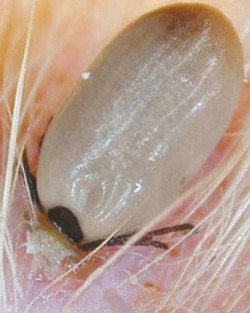
I think the existence of ticks is enough
reason to cast doubt on the existence of God. Unless, of course,
God’s real purpose were the ticks and we other animals
merely their food source.
Saturday
May 16th, 2009 (removed)



 Much more than Michelangelo himself was able
to do. The evolution is clear when one looks at the ceiling, the design
becomes more laboured toward the centre as the, undoubtedly scary
and apparently infinite, unpainted expanse before him diminished.
He evidently became more drawn to the work for its own sake instead of
the pay Pope Julius II offered.
Much more than Michelangelo himself was able
to do. The evolution is clear when one looks at the ceiling, the design
becomes more laboured toward the centre as the, undoubtedly scary
and apparently infinite, unpainted expanse before him diminished.
He evidently became more drawn to the work for its own sake instead of
the pay Pope Julius II offered.