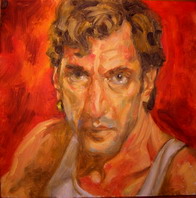
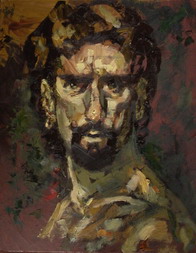
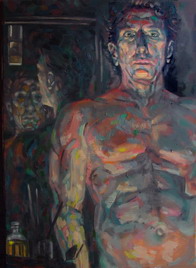
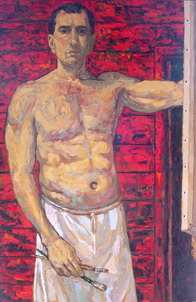
Monday August 11th, 2008
Confidence (250 words)
Among the pleasures of age over youth I am slowly
discovering, some come of simply knowing one's self so much better. It
has been dawning on me that the unquestioning & unlimited
confidence I had in myself in my youth was mere arrogance not because
it was or wasn't justifiable, but because it was founded on my belief
in my strengths- whereas the confidence I feel in myself now, at 46, is
based on an acceptance of my weaknesses.
When I was younger & did something badly, stupidly
or regrettably for whatever reason, I always felt like: Whoops! What
was that? That was not something my concept of the ideal I would do, it
was an aberration, a mistake, there must be an excuse; a reason I will
not repeat.
As I get older I notice as consequence of experience, the accretion of insight, however, that I always do 'that' wrong, it is not in my nature to do 'that' well. As Twain said: Almost every man wastes part of his life in the attempts to display qualities which he does not possess.
I can avoid the circumstances where my shortcomings
tend to manifest & I can try harder when forced to work within that
range, but accepting them as weaknesses, my very own & intimately
understood failings, is liberating & lets me feel a confidence of
greater depth than the one I felt for the inexperienced & abstract
but potentially perfect Paul of my youth's fantasies.
Wednesday August 6th, 2008
How to steal from gullible artists (540 words)
I get letters like the one below almost every day,
their approach varies within a small range but their purpose is always
the same (they merit no more than deletion but this one happened to
catch me in writing mode & before I knew what I’d done I had
written the thoughts it engeandered & sent it! -My answer below):
Paul,
I am an exhibition assistant for Ico Gallery in Tribeca, New
York. I recently found your work online, through www.myartspace.com. The
director of the gallery has asked me to assist him in putting together
some of our shows for late 2008 and 2009. I especially
enjoyed "Patches" and your "Self Portrait." I feel your work would fit in perfectly with several of our upcoming exhibitions.
We look to develop long term relationships with artists
who are committed to succeeding in the increasingly difficult art
world. We act as both agent and dealer for all artists we
represent. Our goal is to increase name recognition for both
Ico Gallery and its artists. Our ground floor flagship
gallery is 2,500 square feet and located in one of New York
City’s most affluent neighborhoods, Tribeca.
Due to the extreme costs and risks of operating in one
of New York’s most expensive neighborhoods we do charge a
representation fee. Our compensation for the first year of
representation should be expected to be around 2500 USD. The
fee can be considerably lower for established New York
artists. Please review our website www.icogallery.com for
additional information about our special events and our popular Ico
Music concert series which is hosted on a weekly basis at the
gallery. If you have additional questions please let me know
and I will pass along your information to our Director.
Best,
xxx
Exhibition Assistant
Icosahedron Gallery
212.966.3897
Dear Ms xxx,
I am 46 years old & have never done anything but paint &
sculpt- if you want a serious, devoted, career artist, who does well
for himself without selling in TriBeCa: here I am.
But I think you will understand that as an
experienced second-generation painter I have a deep mistrust, not to
say righteous prejudice, against anyone but art-materials sellers, who
make money from artists instead of paintings-buyers.
I will not pay $2500 a year or even 5 cents a year for
your 'representation' but if you think you have clients to buy my
paintings than we can begin a mutually satisfying & lucrative
relationship.
The way it works is thus: I dedicate my working life to
creating a valuable product you, in turn, dedicate your working life to
selling; then we share the money.
Please don't contact me again if you as a gallery want
money I made by selling paintings to clients I found without you- I
believe that is technically & traditionally your province
& responsibility in this sort of relationship (the very reason you
can afford the expenses you mention in your letter- because you have
buyers we painters can't find).
I take my share of the money made from sales to
collectors & invest it in the expenses associated with being able
to continue dedicating my time to the manufacture of the product it is
your profession to sell; you take your share of the money & pay the
expenses of the address that attracts buyers my studio address does not.
You feed off of the weak & exploit naïve
hopes. I’m sure the innocent painter who invests his day
job’s money with you will never see it again; I think you could
find a sales job with more dignity xxx, shame on you.
Sincerely,
Paul
Postscript: Ms xxx, who signed the letter above, wrote
asking me to remove her name as her employment with the gallery ended
badly & she didn't want to be associated with them for fear it
would damage her reputation.
Comments
Sunday July 27th, 2008
Priests behaving badly (690 words)
I have been a hopeless atheist as long as I have been a
keen student of theology- most of my life. My study & personal
experience of a great number of religions, their philosophies &
histories has, for many years, been pushing the Catholic Church closer
& closer to the bottom of my list of consciously dishonest, corrupt
& harmful of all.
When the present Pope, Benedict the XVIth, recently
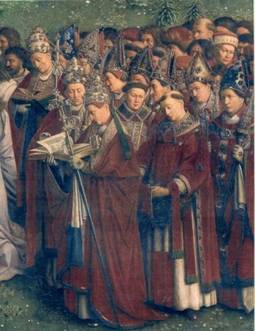
apologized in name of The Church (before 800 solemn Bishops) for 1500
years of sexual relations with the Faithful’s children, it gave
me pause for thought.
The generalised response to this decision was applause
for the Church’s new sincerity & openness to change, but I
wonder just what accepting that forgiveness, however genuine the
apology, actually means. The fact these men in robes, the supposed
guardians of their flock’s spiritual health forced their penises,
hard with excitement, into the colons of pre-pubescent boys afraid of
their authority, calls for something more.
It was never a secret, everyone has always known the
abuse of power in the form of brutal rape of defenceless &
pre-sexual humans by priests was happening. Catholic orphanages
routinely turned out boys trained to homosexuality whether they were by
nature or not. But now as the Church loses its long held
authority (both moral & legal) people protest & the Church
apologises…
I think the apology, even more than its absence, points
to a pressing need for fundamental re-evaluation by the Church rather
than our forgiveness.
I can also think of gestures by the Church that might
convince me better of their sincerity than politically-decided &
unfelt words. How's this for an idea? - The Vatican sells off one small
room of the thousands that hold our cultural heritage from Aristotle's
manuscripts to secret gospels; paintings & sculpture by all the
great artists in history, or even one of the rooms piled like a
Pharaoh's tomb with finely wrought gold & rare gems offered as
bribes to cooperation by heads of state throughout modern history.
All the important museums in the world would fight over
these objects & more people would be able to appreciate their
ancestor's legacy than the few given permission to visit the locked
dungeons of the richest State on earth.
With this money they might, say: buy ten acres for
every starving farmer in Chiapas with plenty left over for fertilizer.
(Or tractors & seeds or whatever it is the poor sods need down
there.)
Instead, I remember the quick tour of Mexico the last
Pope, John Paul, did to animate the dwindling few, old-world Catholics
who still think the Pope is practically God's incarnation on earth. The
Church decided that despite the centuries of financial support the poor
Mexican had provided, it couldn't afford to pay for the trip out of the
Vatican's coffers.
A deal was made with a potato chip company who, for a
couple of million bucks, were sold the exclusive right to the Pope's
image. They used this right to print flimsy coin-sized medals of his
face they then offered in each bag of chips; & the starving farmers
in Chiapas spent their pennies on packaged potatos in order to get
their hands on the bit of plastic.
If not the principle than just as a question of Papal
dignity, this is worse than the holy relics the Church used to
fabricate in their monasteries for profitable sale. Which allowed,
among other things, the purchase & building of some of the most
extravagant architecture in Europe at the same time it was being
decimated by Black Plague.
And I'm convinced these clever administrators
negotiated the deal in a way that resulted in profits to both
companies, the Church & the potato chip's, while the poor Catholic
Faithful get poorer & have more children.
The Church has always required payment of one sort or
another to provide forgiveness to confessing sinners, now that it is
they who confess & ask for forgiveness, where is their donation?
May the shame you apologize for actually befall you Benedict- thus I curse you.
How to make a painting (2260 words)
When I was a child my younger sister, my mother & I, followed the deeply serious, obsessed, indeed: possessed
painter who was my father (fifteen years my mother’s senior),
from one country to another without more reason or motivation than his
hunger for life.
I guess this gave us kids a backdrop to life that was a
little different to those we came to know in the various places we
lived. When I was six & it came time to leave our idyllic &
ancient stone farmhouse in the mountains of Tuscany in order to move to
Florence where I could begin school, it was effectively my & my
sister’s first exposure to a world not of my mother’s
making & description.
Our first toys not made by my mother were pre-historic
human bones my father found deep in a cave in Sicily where the locals
wouldn’t enter for fear of the Cyclops who lived there, & I
remember their oh-so-dry whiteness well. (There was an ancient Greek
society living isolated there in Sicily till long after Greece's
conquest by the Romans, hence the Cyclops).
At the age of six I had never seen a television or been
to the cinema & I remember clearly the first image- in black &
white, a turning world on a black background. Probably no more
sophisticated than a shot of a spinning globe on a desktop that
never-the-less had a deep impact on me & led me to the only
conclusion my uninformed mind could- it was a mini-theatre with little
people inside it. Not to mention the images that haunted me for months
from the 1930’s King Kong that was my first film on a big screen at about seven.
And when my mother tried to explain what the word
‘thief’ meant she had some trouble conveying the concept to
me. Finally she described someone planting a seed, caring for the plant
that grew from it for the purpose of eventually eating its fruit but
before he gets a chance someone else comes along, picks the fruit &
eats it. "That is a thief" she concluded & I, at six years old,
cried bitter tears at the discovery such evil existed in the world.
When my Dad left us I was still a child, my mother
moved less frequently but there were still a few countries &
various moves within countries in the short few years before I hit
sixteen & in my boundless magnanimity decided it would be
unbecomingly cruel to continue to let the world that waited for the
privilege of my presence, suffer my absence any longer. I boarded my
first aeroplane alone at that age ready to disembark to the applauding
crowds gathered on the tarmac to welcome me.
As things have turned out it has been a tad more difficult to impress the world than my initial expectations projected…
Having changed the cultures with which I live so many
times, added to the fact I have no hometown, no childhood friends, no
anchor cast in any particular country, has given me a feeling I am long
accustomed to: Everyone else shares a common knowledge I am ignorant
of.
Among the other effects this history has had for me has
been the saving of very few mementos (because of the need to constantly
distill possessions to what will fit in a few suitcases & a sea
chest) & yet, my mother has managed to hold on all these years to
one of my early paintings, naïf but expressive, a self-portrait
lit by a candle on one side throwing half my face into dramatic shadow.
It is oils on board & dated 1966, when I was four.
So it came to me that if I find myself living in a rich
country or a poor one, town or countryside, among Buddhists or Muslims,
though I can make sincere, intimate friendships & even fall in
love, I also know that the history of a culture grown thousands of
years in the soil of Hinduism, for instance, will always provide a
fundamental divide that goes beyond our difference in ancestral
knowledge & beliefs to a difference in our concept of our home- the
universe, that not only will never meet but cannot even be described in
words.
Or to give an example more familiar to most readers
& yet no less extreme: Despite my years in the 'States there is an
entire backdrop of television shows shared as children, early
indoctrination of patriotism (different to most other countries)
history & historic attitude*; sports & an indigenous sense of humour which I do not share.
The string of similarity in the course of my personal
history is made of the smell of turpentine & linseed oil, of
memories of us four all sleeping in the same bed, my Dad & Mum with
heads at one end & my sister & I the other, while the big room
in the house was dedicated to my Dad’s studio. Never running out
of art materials though it wasn't unusual for my Dad to paint a
painting on either side of a canvas for lack of more, neither was it
unusual that we ran out of food without money to buy more. And growing
up with heroes that weren’t politicians, sports figures,
Hollywood actors or popular singers but painters dead these 500
years…
To the feeling of my own ignorance of cultural
imperatives wherever I find myself, my having lived always in studios,
my Dad’s, my Mother’s & my own, has added a mistaken
assumption that others understand the things that were common knowledge
where I came from, like how a painting is made.
I don’t mean ‘painter stuff’ like an
understanding of materials which, nowadays, with everything
manufactured commercially even most painters don’t bother
learning, I mean, instead- the abstract concept behind ‘making a
painting’.
From time to time I have taken students, usually with
art degrees or often, architecture. Time & again I find myself
stressing the same lesson & yet it was only recently that the idea
gelled & I realised the theory behind this lesson is of the most
crucial importance & that most people aren’t aware of it! It
was as a revelation to me!
Because a canvas is a two-dimensional surface
people assume the process of covering it with a painting is a
two-dimensional process. But rather than a question of width & height it is one of a depth built in layers. Just as Paint by number
kits start kids off with the wrong approach all amateur paintings
reveal this same misunderstanding. Making a painting is a
three-dimensional process more akin to focusing a camera than shooting
a photograph with it.
Moving to the surface too soon instead of building up
to it is the most common mistake & once one begins a level of
detailed observation that belongs to later layers he commits himself to
those hard & clearly defined brushstrokes instead of being free to
improve them.
The painting is built up a little at a time &
though each layer makes the painting move toward one’s personal
vision of perfection, the brushstrokes the better ones cover, were not
mistakes that were fixed but rather a necessary part of the process;
just as an eraser can remove mistakes or be used as another drawing
implement alongside your pencil.
Many so-called painters today unashamedly use
projectors instead of drawing & if they are good at judging colour
they can conceivably fill in the drawing they have projected in a
single layer of paint. I have even been in murals painting factories
where thirty people are busy filling in colours, chosen & premixed
by a computer, on large canvases that go out to fashionable clothes
store chains & suchlike. Without the layers it is craft, not art.**
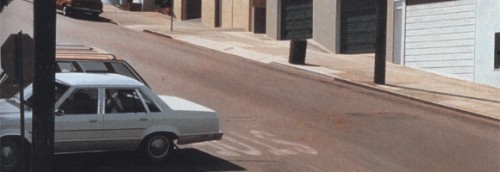
An example of hyperrealist painting by Robert Bechtle
I often start a painting without a drawing; I squint my
eyes to separate the subtle tonal differences & bright colour
contrasts into the three basics, light, dark & middle-tone (in a
quasi-monochrome of maybe Raw Umber with Naples yellow) with reduced
colour saturation (by squinting one reduces the amount of light that
enters the eye forcing it to count more on the rods & less on the
cones of the retina (i.e. tone instead of colour) making it easier to
judge the relative tones instead of confusing a saturated colour next
to a pale one as a difference in tone instead of hue).
I then paint these three tones with a large brush &
a confidence that might make someone watching think I was sure of being
exactly right with each one, though in truth, I do feel it is perfect
when I apply it, experience has taught me most if not all of these
initial brushstrokes will take correction in the next layer (&
having something to correct makes a very good start).
As the layers build up & the brushstrokes become
smaller, each layer will give some brushstrokes that were indeed
perfect (subjectively, of course). It will be these brushstrokes,
recognised & left alone that will give the finished canvas its life
& verve- the larger the brushstroke the better***.
If I want to continue working on a canvas
‘focused-in’ to the degree I just described, I can reach
very small observation before moving from stiff hog-hairs to soft
sables. At this stage the careful observation of slight change in
tone hue & colour begins making the brushstrokes disappear as each
is so close to the one next to it (i.e. because the gradations are so
gradual). If I then want to move on to a series of translucent glazes I
can make the evidence of its having been painted disappear altogether.
In my opinion a painting taken to this point has far
too much information for the viewer to able to enjoy it emotively
instead of only intellectually, it is the difference between poetry
& journalism. He may say: “Wow! Look at the skill evidenced
by the careful observation in this painting.” Or worse: "It's
good; why- it looks just like a photograph" without realising that a
life dedicated to imitating a simple machine (the camera) is an insult
to one who dedicates his life, instead, to the pursuit of art.
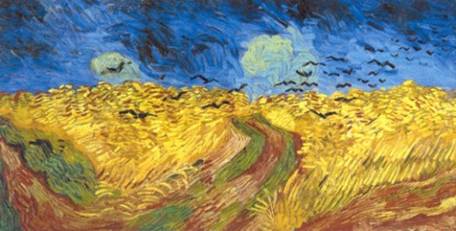
Van Gogh, by contrast, gives the viewer a house &
lets him furnish it with his imagination. If one looks at his crows--
painted like a child’s, with one crooked brushstroke each--
flying over the wheat fields bending with the wind under a dark &
menacing autumn sky, one can even reach a point of feeling the
depression that led Vincent to shoot himself after applying the last
dab of paint to it.
It is those brushstrokes applied with confidence in
their perfection that make a painting great. The same size brushstroke,
of the same colour, tone & hue, placed on the same bit of canvas
but painted cautiously with a small soft brush, will not work.
So all one has to do is learn to recognize the lucky brushstroke & try to avoid covering it with more paint!
footnotes:
* For instance the American
cultural stress on individualism where children are routinely taught
they can be whoever they want & do whatever they propose, compared
to Oriental children who are reprimanded for being different to others.
The difference is that between Confucian dialectics & Jefferesonian
political theory.
Each attitude has strong arguments & benefits to
support it & yet, generally speaking, neither culture questions the
correctness of their own way- early indoctrination few re-evaluate. And
the occidental who becomes a monk in a Thai temple has not gone over to
the other side but rather- exercised the very same cultural imperative
that made him believe he could become what he proposed.
Even what might be called a superficial difference can
have profound effects on human interaction & understanding. The
facial & physical gesticulations that accompany southern European
speech make them look like overstated comic book characters to the
Oriental eye whereas what they consider a dignified & considered
reserve expressed as a contemplative & silent motionlessness, is
merely frustrating inscrutability to the European.
More examples? If you tell someone from the 'States:
"You are ambitious" He will take it as a compliment. If you say the
same to a Spaniard, it is an insult. Whereas if you tell a Spaniard
he's proud, he will hear it with pleasure & thank you- say the same
to a Japanese & you speak fighting words! Return...
**
To give a concrete example of something specific where nothing but
layers will do: If you like to paint, say: trees (as I do). You may
want two or three tones that represent light & shadow even on thin
branches. If you paint the light beside the darker tones it will always
tend to look like an outline & will have that difficult-to-define
but recognizable amateur quality. If instead, you paint the whole
branch the colour of the darkest tone, let it dry & then add the
lighter tones allowing the dark to show where you want shadow- it will
be more convincing. Return...
***
I recently saw an Exhibit at Sevilla's museum of fine art, of the
miraculous paintings Sorolla did for the Hispanic Society in Brooklyn
between 1914 & 1919; some were almost 8 metres wide by 4 tall. When
approaching one of these huge canvases to study his brushstroke I found
some that could only have been painted with a house-painting-brush
& at a metre long looked like they described nothing at all- until
one backed away a few metres to see it defined with dismaying
precision, the light shining on a horse's flank, or maybe the
silhouette of a figure: now that's painting! Return...
Wednesday July 23rd, 2008
Scots & their oats (490 words)
A traditional Scots porridge is made of the left-over
oats from bread-making. They are placed in a clay pot & left with
water & salt at the back of the wood-burning oven once the
bread’s finished baking. The oven takes all night to cool &
as it does the oats bubble & congeal into a nutritious &
stomach filling gelatinous mass eaten still bubbling hot in the cold
northern dawn.
My Dad was an archetypical, kilt-wearing,
bagpipe-playing Scot who grew up in Glasgow. And yet I, who have never
done more than visit Scotland, have a better right to wear a kilt than
he had, being as I am, Son of a Scot while my Dad’s own father
(& mother) was a full-blooded Ashkenazy Jew from Russia.
A professor of English history once explained to me the
importance oats had in the long running struggle between the powerful,
well-manned, armed & trained English military, with the wild
disorganised clans who fought with little more than hand-forged axes
& passion.
He explained that feeding the British army was a large
consideration in time, transport, expense, supply sources & storage
as well as, organisation & even the actual cooking & feeding
logistics. This put the English at a big disadvantage to the Scots
tribes who simply filled their pockets with oats, moved whenever they
wanted & ate wherever they had water.
So when my Dad saw me making oatmeal the American way
with milk & sugar he never failed to remind me that the correct
& manly way to eat oatmeal was with salt & water.
When my Father died I went to London for the funeral
& a few of us staid with my father’s third wife who is from
Laos & couldn’t therefore, be in the house alone so soon
after his death for fear of his ghost.
An old friend, Peter the Piper, slept in one room &
I another. One morning I was the first up & rummaged through the
kitchen having to settle on tea instead of coffee & a bag of oats I
found in a cupboard.
When Peter walked in to find me stirring my oats in
sweetened milk I decided to take the initiative & cut him short
before he had a chance to mock my eating oats like a child: “No
need Peter, Dad’s been telling me all my life I make oats the
wrong way!” “What do you mean?” Asked Peter.
“Well you know, in Scotland they’re made with water &
salt…” “Water?” Said Peter, confused &
righteous at the same time. “I mean, Americans make oatmeal
with milk & sugar…” “MILK?!” Now genuinely
alarmed- “But if you add water or milk to oats they might get all
soggy.” “Hu?” I retorted intelligently. “How do
you eat them then?” I asked, “Well, as they come, you know: out of the bag.” (Bloody Scots!)
Friday July 18th, 2008
Life's greatest suffering is always due to the stupidity of others because, by great
good luck, we are always able to excuse our own.
Wednesday July 16th, 2008
A note about signatures on paintings (530 words)
In a canvas not unusually long or tall in proportion to
its other sides, the signature should be of commensurate size- too
small & it looks silly, too large: It takes over the focus of the
composition. But in its right size it does inevitably form part
of a composition, sometimes unbalancing, sometimes complementing &
sometimes even anchoring an item of the composition that wanted to
slide off the edge or bottom.
Which size is correct? Well, I’d say: It should
be clearly legible from a painting's appropriate viewing distance
(generally speaking- three times the diagonal) but should fade at
greater distance.
A painter once asked me: “My signature colour is
Cadmium red, what’s yours?” But one can’t afford to
commit to a signature colour if the signature is part of a composition.
As such, one must choose the colour & placement just as he did for
every other element of the composition, i.e. uniquely to the canvas.
My mother is a restoration artist or, conservator, as they’re known these days- she  performs
complex processes on antique paintings in order to clean them, replace
missing paint, make a hole disappear or even separate the paint from
the degraded canvas to give it a new one to lie on.
performs
complex processes on antique paintings in order to clean them, replace
missing paint, make a hole disappear or even separate the paint from
the degraded canvas to give it a new one to lie on.
Judging by the frequency she runs into the problem it
seems many painters don’t realize that varnish, Dammar varnish,
is designed to be porous so the oils underneath can breathe, stretch
& contract with heat & humidity changes; but this also means it
is porous enough to allow dirt to infiltrate it.
On average, depending on the circumstances in which the
painting is hung & how well the protective varnish was originally
applied, every 50-100 years it must be removed & replaced before
the dirt reaches the paint layer (it is always a little magical to see
a landscape, under my mother’s careful ministrations, go from its
green skies made of the original blue overlaid by a translucent layer
of varnish yellowed by dirt- back to the blue it was when it left the
artist’s easel).
What she often finds is that the artist has signed after
applying the varnish & runs the danger of having his signature
wiped off by an inattentive conservator when it is cleaned in the
future.
The four corners are the commonly chosen but the middle
bottom is also appropriate & when a canvas is being particularly
exigent & difficult, I have sometimes found the solution in one of
the upper corners but in vertical instead of horizontal. Always being
careful, of course, not to sign so close to any edge that the frame
will cover it, or worse: part of it.
For the ones that just plain refuse to have their
compositions altered by a signature I have two solutions: The back of
the canvas or on the front but in the same colour as the background I
paint it on. This results in its being difficult to see but I figure if
the painting has value for future generations then the experts will
find it, & if it doesn’t- what difference does it make?
TOP
Monday July 14th, 2008
Bob Dylan (710 words)
I remember being about 8 years old when Dylan was 28, it was 1970. I sat in a room  in
my Mum’s house in Florence in the company of a bunch of nice,
young, rich, American hippies. In Italy ostensibly to study art but
really dodging the draft like their poor brothers were doing in Canada.
Dylan sang a weak strain in a transistor voice from his latest album- Self Portrait-
vinyl, under the needle of a plastic low-fi record player. The kids
(big, wordly men to my eight years) talked of him in reverent tones & I
found the courage to speak up & ask who he was. One of the young
men turned to me & said simply (but with a gravitas & passion
that has stuck these 38 years) “He’s a genius”
in
my Mum’s house in Florence in the company of a bunch of nice,
young, rich, American hippies. In Italy ostensibly to study art but
really dodging the draft like their poor brothers were doing in Canada.
Dylan sang a weak strain in a transistor voice from his latest album- Self Portrait-
vinyl, under the needle of a plastic low-fi record player. The kids
(big, wordly men to my eight years) talked of him in reverent tones & I
found the courage to speak up & ask who he was. One of the young
men turned to me & said simply (but with a gravitas & passion
that has stuck these 38 years) “He’s a genius”
At the concert he gave in Jerez de la Frontera’s
bullfighting ring the other night, he was dressed like a nasty joke by
Gaultier at his cattiest, never once looked at us, his audience, &
rather than singing his brilliant lyrics he decided to just repeat two
sounds the entire evening that sounded something like: bluu & ooou
as if attacked & moaning with a frightful case of acid indigestion.
Combined with the fact he changed the melodies of all our old
favourites, we none of us, had any idea which song was being
interpreted at any given moment.
The strange costume he has settled into in this last decade or more, is a wide, flat-brimmed, white Stetson which suits his Jewish face as
well as a yarmulke might John Wayne's or a Muslim turban- George
Bush's. A beautifully cut but badly designed black suit with Marlene
Dietrich fake shoulders & brass buttons that rose to just under his
chin turning his toothpick body into a, well: toothpick dressed as
Marlene Dietrich. But the touch that must have had Gaultier rolling
with laughter at his own dark & disturbing humour as soon as Dylan
left his dressing rooms, was the single brass button that sat over each
of his nipples.
is a wide, flat-brimmed, white Stetson which suits his Jewish face as
well as a yarmulke might John Wayne's or a Muslim turban- George
Bush's. A beautifully cut but badly designed black suit with Marlene
Dietrich fake shoulders & brass buttons that rose to just under his
chin turning his toothpick body into a, well: toothpick dressed as
Marlene Dietrich. But the touch that must have had Gaultier rolling
with laughter at his own dark & disturbing humour as soon as Dylan
left his dressing rooms, was the single brass button that sat over each
of his nipples.
The audience was made up largely of middle-aged men
dressed in neat grey haircuts, pink Polos, Chinos, sailing shoes &
little cashmere sweaters wrapped around their waists (just in case it
got cold here in the southernmost part of Europe... in July...) hard to
believe they were the same ones that remembered to take drugs to
Woodstock but forgot the food!
People did pass joints but then, here in the south of
Spain, they do that wherever you go, but instead of a huge audience
showing their love with waving, lit, cigarette lighters, we were a
small one & the lights were provided in the wrong direction by a
thousand mobile ‘phones taking bad digital photographs.
I’m sure that of the million images generated that night not one
was worth looking at but then no-one wanted photographs of Dylan, his
band or the simple black stage but rather, just as we used to buy
t-shirts commemorating the concert, they only wanted proof they had
been there in a historic moment… (in this case, not a
musical event but the death of a generation who thought they formed the
beginning of a new world order based on love & peace)
His five-man backup band was excellent & never
missed a note the entire evening (even when Dylan missed his entry)
& so I was curious who they were. Finally in the last words of the
concert & the first directed at us, the audience, he began
introducing them while waving his arm in no particular direction: "Bluu
ooou ooou, bluuooou…"
Could this be the same man who led a generation &
shocked the establishment with fiery arrogance, un-doubtable truths
& brilliant poetry composed of common but precise colloquialism?
Didn't matter to me, if I want to hear him sing his
best songs in a moment he actually felt them- I have all the recordings
right here, I only went to see an old friend... (though it's been a
very long time indeed since I prefer Jazz)
But, I wonder, why doesn't he quit? He certainly showed
no sign of enjoying it & I rather doubt he needed the money from
the few tickets he sold us.
Saturday July 12th, 2008
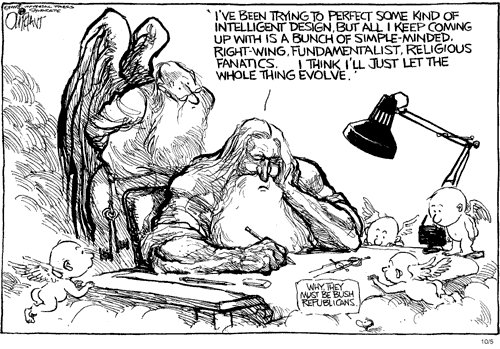
A study reported in Nature in 1998 found that
only 7 percent of the members of the elite National Academy of Sciences
believed in God. For biologists the figure was just 5.5 percent.
Monday July 7th, 2008
Theoretical physics & me (1560 words)
I remember discovering biology at 12. When I asked
questions that had nothing to do with our exams or stayed after class
to timidly ask for deeper explanations, I remember one sixth grade
teacher asking me, why the fascination? I answered confidently &
without hesitation: “Because I didn’t know such
explanations for how the world works existed.” But when she went
on to ask me why this fact interested me I found my twelve year old
mind wasn’t able to formulate an answer because it couldn’t
make sense of the question: Hadn’t I just answered that question?
Wasn’t the fact the answers exist enough to explain wanting to
know them?
In a moment of tender anguish described by Brian Greene in the foreword to Elegant Universe,
he explains how as a boy it came to him that there had been a moment of
history when it was theoretically possible for one man to amass the sum
knowledge of humanity but that, that moment was long gone. Greene,
unlike me, was at twelve being tutored in maths by a Columbia
University professor since he had already  outstripped
any of the teachers available to a high school student, much less an
Elementary one. He goes on to explain it was this boyhood angst at not
being able, even in potential, to learn all there was, that eventually
drove him to a career in physics dedicated to a Unified theory which,
in essence, is everything there is to know.
outstripped
any of the teachers available to a high school student, much less an
Elementary one. He goes on to explain it was this boyhood angst at not
being able, even in potential, to learn all there was, that eventually
drove him to a career in physics dedicated to a Unified theory which,
in essence, is everything there is to know.
Although I never lost my interest in biology by the
time I reached the eighth grade I realised that its study inevitably
led to that of chemistry. I followed theoretical chemistry through to
my junior year at university when the application necessary to keep up
on its study had too little application for the art degree I was
actually trying to complete for me to continue sacrificing the time. I
had always hated the lab, couldn’t care less how chemicals reacted to each other, I only wanted to know- why. I didn't want to make anything, I just wanted to know.
I had, however, learned enough to realize long before university that
the study of chemistry must lead to a study of physics & yet, I was
in my early/mid thirties before I suddenly took up an interest in its
study on my own.
It began with a book a girlfriend gave me, saying:
“I want to know something about this subject but I can’t
understand the book, so can I process it through your brain instead?
Will you read it & then tell me about it?” It was David
Deutsch’s (the director of theoretical physics research at
Oxford) Fabric of Reality & it was as a hand-grenade
inside my skull. And yet, I noticed that without the basics, which I
was not in possession of, most of the information was escaping me.
And so, I picked up easy, popular books, like Bill
Bryson’s, Steven Gould's & Brian Greene’s, & then
began looking for the books by the men referred to in these others
& so discovered why time, as we perceive it: lineally, does not
exist. Hawking & Dawkins*,
Planck, Popper & Rank, Heisenberg’s important uncertainty-
& Bohr; Bell’s theorem, Schrodinger's Cat, Super-symmetric
string theory, parallel universes (multiverse, instead of universe)
& “spooky action at a distance” as Einstein mistakenly
maligned it.
I familiarized myself in some small way with that urban
legend: Quantum Mechanics; always remembering Feynman's admonition: he
who claims to understand Quantum Mechanics, doesn't understand Quantum
mechanics. And had therefore, to come to accept the fact that Quantum
Mechanics made nonsense of laws that worked to explain all the universe
except for the selfsame elemental particles that make up its very
fabric.
I find the avant-garde theories wonderful for
one who enjoys, as I do, unexpected & unpredictable neurochemical
activity in one’s own brain. Indeed, I have seen some of the
leading theoretical physicists themselves interviewed: their eyes like
plates as they explain how the universe is made, why they believe these
theories to be true & which experiments support them; while
admitting with wonder that their puny minds are incapable of actually
imagining these same truths.
In the end though, the part of my superficial,
autodidact, store of information which turned out to be the most
fascinating to me was the basics, what the General & Special
theories of relativity mean (& why Newton was wrong). Why the
curvature of space by the gravity of massive objects shapes our
universe, how time is incorporated as fourth dimension to the three
dimensions our perceptions are capable of recognizing. Why nothing with
mass can travel faster than light**
or how Heisenberg showed that real space, in the sense of nineteenth
century ‘ether’, cannot exist. That however small the
parcel of space, of vacuum, examined, one can never be sure it does
not, or will not, contain matter before, during, or after examination.
I remember a formal dinner I had attended before my
unguided & sloppy study of physics began, where among the
interesting guests, I found myself with the luck to be seated beside a
research astronomer working at an important observatory in Texas. Never
being one for small talk my conversation with him quickly turned to my
trying to pump him for an eight year university education over a three
hour meal.
I also remember that I at one point interrupted some
explanation of his to ask him how it was that he seemed to be referring
to the Universe as finite. Even if the existence of all matter ended at
a certain distance from us, beyond that there could only be infinite
space because: “What could possibly exist in the absence of
space?”
It was at that point I lost him to an apologetic shake
of the head, so much to say: “We haven’t time enough for me
to fill in the ignorance evidenced by that question” & I was
forced to turn to other guests for fear of being a bore to the
astronomer (though actually, I noticed he ate in silence after that as
no one else seemed to think his world of mysterious knowledge
interesting).
I realize now that the answer to that question, &
the conscious conceptualizing of the hypothetical construct of a single
dimension which admits no volume, was the most fascinating &
primordial bit of knowledge in the whole field of physics to me. If one
stops to think about it the concept is not precious or clever, anyone
might consider it, but the truth for most of us is, that unless
directed by a particular line of reasoning, thinking of the existence
of a single dimension without the others, doesn’t occur to us.
The Singularity. The place where at one time (15 or 20
billion years ago) all the matter in the Universe was; though it
existed in a single dimension, i.e. without width, depth, height or
time. A single dimension is in essence, the same as no dimension
because whichever of the four you pick, without at least one of the
others, it becomes indistinguishable from the others. The phrase I
began this paragraph with: “The place” was necessary to
construct the sentence but in fact, it has no meaning. One naturally
imagines the Singularity which suddenly explodes into the Big Bang, as
existing in infinite space, what else? But no, before the Big Bang
& the physical laws it introduced, there was no space…
In just under a third of the first second after the Big
Bang, matter extended into a Universe 150 million light years in
diameter. Which would imply matter moved at something like 1500 times
the speed of light (if I remember my figures badly I apologize but I am
neither mathematician nor am I interested in accumulating such details
but rather the abstract concepts behind them).
One thousand five-hundred times the speed of light? But
that, as we know, is a physical impossibility- not allowed by the laws
of physics that pertain, by chance, to our Universe. And there the rub:
As matter moved, it did not move through space, but rather created
space because of the effect of curvature its mass & speed had.
Matter broke no physical laws by moving at lightning-
times a gazillion- speed, because prior to the end of the first third
of a second after the Big Bang, those laws hadn’t yet been
made…
And a Universe that is curved must eventually meet
itself, hence the finiteness that does away with the need for something
else (like space) after the end of a lineal Universe.
Fantastic, no? Physics is becoming the new metaphysics.
*
Yes, I know Richard Dawkins is not a physicist (& the truth is I
discovered him in the late 70's but couldn't resist the alliterative
quality of his name!), but he is something of a philosopher
& his oh-so-lucidly described concept of reality sheds
understanding in areas of physics. Philosophy was, after all, the
mother of the sciences until the twentieth century. How did she lose
her reign? Probably the same way art lost its place in society: by
becoming too bloody difficult to understand! Return...
**
As matter accelerates it gains mass. As it approaches the speed of
light its mass becomes infinite which would require infinite energy to
further accelerate its motion. Return...
Sunday July 6th, 2008
Most men lead lives of quiet desperation
and go
to the grave
with the song still in them.
HENRY DAVID THOREAU
Friday July 4th, 2008
Faust & Mephistopheles (550 words)
If Christophere Marlowe hadn't been killed at the
tender age of 29 in 1593, history might have made him his contemporary,
Shakespeare's, equal or better. He was killed with his own blade
ostensibly in a brawl that followed his questioning 'the reckoninge' (the bill) after having eaten & drunk at an Inn, but actually his death is shrouded in intrigue, complot & politics.
Some historians suspect he was about to betray Sir
Walter Raleigh's plot against Queen Elizabeth & was killed for that
reason by the tavern owner, Ingram Frizer, who was also a known agent
of Raleigh's (& was found not guilty of murder on the grounds of
self-defence).
How silly Man has been throughout history in repeatedly
thinking politics can outweigh art in importance. How much more
important to us, some fifteen generations later, might have been
Marlowe's writing than 20 years difference in Raleigh's date of decease.
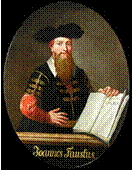 Marlowe’s play The Tragicall History of Doctor Faustus,
was based on the mythologized life of the German Renaissance alchemist
& astrologer Dr. Johann Georg Faust, who lived from about 1466 to
1540.
Marlowe’s play The Tragicall History of Doctor Faustus,
was based on the mythologized life of the German Renaissance alchemist
& astrologer Dr. Johann Georg Faust, who lived from about 1466 to
1540.
It was later taken up as an epic poem by Johann
Wolfgang von Goethe who completed part 1 in 1806 & part 2 the year
he died in 1832; 26 years later.
When Marlowe’s Dr Faustus trades his eternal soul
for infinite knowledge he asks Mephistopheles: “How comes it then
that thou art out of Hell?” To which he replies: “Why- this
is Hell, nor am I out of it” which he later explains:
Hell hath no limits, nor is circumscribed
In one self place, but where we are is 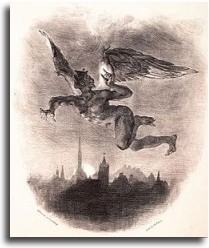 Hell,
Hell,
And where Hell is must we ever be.
As Wendel Berry points out on the subject of Dr Faust’s unquenchable desire for knowledge, John Milton comments in Paradise Lost- book VII, in regards to Adam’s wanting to be told the story of creation, the Archangel Raphael tells him:
Knowledge is as food, & needs no less
Her temperance over appetite, to know
In measure what the mind may well contain;
Oppresses else with surfeit, & soon turns
Wisdom to folly, as nourishment to wind.
Thinking of these great poets & the concepts of
good & evil, knowledge & wisdom, power & peace, reminded me
of a bit of advice by Sir Arthur Conan Doyle given to me as a boy
through his main literary character: Sherlock Holmes, & never
forgotten.
In one of the detective stories (I can’t remember
which or even the circumstances in which the scene plays out) someone
says something about the earth orbiting the sun (or the moon the earth)
when Sherlock expresses surprise: “Is that so? I didn’t
know that.” To which one of the other characters voices his
astonishment: “How could a man of your uncommon intelligence
& wide ranging knowledge, not be aware of such a common
fact?” To which Holmes answers: “No, you are indeed right,
I was in complete ignorance of the fact & I shall now endeavour to
forget it as soon as I am able”
Knowledge outside one’s own field of interest is
trivia & an excess of knowledge (as defined by- more than that
which has application) is more harmful then favourable to original
thought, discovery, or, by the same token: art.
Tuesday July 1st, 2008
The Twentieth Century (1680 words)
When history looks back on the 20th century, which will turn out to be its defining factor?
If I say: 17th century; one might think of Louis XIV
who was king of France for 72 of those 100 years (longest reigning
monarch ever in Europe). Or of the fundaments of science & modern
philosophy, Galileo, Newton, Descartes, or perhaps the colonization of
the New World; while forgetting the 30 years war, the Great Turkish war
& the Dutch revolt or English civil war. Or even, for that matter,
the beginning of the Edo period in Japan or the Mughal Empire in India
that marked the start of its dynasty’s 300 year ascendancy which
oversaw a true Renaissance in Indian art & architecture. The Qing
dynasty in China or the Ottoman in the Middle East, North Africa &
south-eastern Europe.
Every generation, much less each century, finds some
reason to feel they are living a particularly important moment in
history though, despite what the papers & television would have us
believe, few moments, few men, in few places, actually have an impact
on humanity that is remembered as important a few short centuries later.
Having said that, & despite recognizing my bias due
to having lived most of my life in the 20th century, I think I can say
objectively that it introduced some unprecedented innovations that have
indeed impacted on all human history to come.
Einstein? Who taught us the universe actually takes a
form very different to our perception of it; that its truths are so
foreign to the human-perception of its reality, that it is nearly
impossible for us to imagine it in any real way. Wow! But no, I
don’t think so, Einstein’s wondrous truth doesn’t
offer enough interest for most people to even bother finding out what
it is. The same will probably turn out for Bohr, Planck &
Heisenberg, who cares if physical law is entirely different to our
perception of it? To most, Quantum Mechanics is mere urban legend.
How about Ford? Though not the inventor of the internal
combustion engine he did, practically single-handedly, give the world
the car & got rid of the horses with whom man has had a pact since
before written history. But I don’t think so, though the change
was a big one & with wide ranging ramifications to society, in
three hundred years I suspect it will be seen as a first awkward step
(& short period) of an evolution that will become something very
different; the car will become a fondly remembered dinosaur.
Two wars that killed about 100 million? (if you include
the 20 million that died in the first world war of avian flu- Spanish
Influenza) might those atrocities & resultant reconfiguration of
global power define the 20th century? In a world of an unprecedented
seven billion, 100 million, will seem more trivial than the destruction
of Dresden will, three hundred years from now. Most people even today
could not tell you clearly how either war began or ended.
Churchill? Hitler? Stalin? Ghandi? Great characters who will be
remembered & romanticized just as we do Napoleon today, but their
impact on multi-century history will be inconsiderable.
Karl Marx? He did change the lives of half the
world’s population for much of the twentieth century. Nah! But
for a few historians, most of us would be hard put to define the
borders of the six hundred year old Ottoman Empire which lasted till
after the end of the First World War. A failed political structure that
lasted 60 or 70 years will soon be forgotten. I think Mao Zedong has a
better chance as the man who destroyed 5000 years of deep Chinese
culture in 50.
How about art? Just as it defines the sixteenth century
for most Europeans. Picasso maybe? In my opinion the art history of the
20th century will eventually be seen as a century in search of a
personality. A time of redefinition & confusion. Some great artists
whose work will perdure but as a century in art, I think it is looking
for something it won’t find again until sometime in the 21st
century.
What about film? Or film in its form as television?
Television has had an undeniable impact on world culture & a
blurring of the edges between cultures. It has had an effect on human
character (or at least, personality), dissemination of information,
fashion building &, of course, teaching simpler cultures that
without the things television sells, they are in fact: poor.
Television has also trained us in attitudes, humour, visually*,
& changed the way we understand a story. A 1950's film, for
instance, might show a character pass through his front door, get in
his car, drive & arrive at a destination whose door in turn, he
enters. Today's television can show a scene change from one interior to
another & we, the trained audience, automatically fill in the trip
in-between.
I would argue, however, that like the mobile telephone
which had a profound affect on our lives, we assimilated it &
became used to it without any fuss at all. Indeed, it became difficult
for me to remember life without mobile 'phones just a few years after
their introduction though for most of my life the only person with a
mobile 'phone was Dick Tracy. And so I think television will not be
remembered as the tool of social change its invention actually was, but
rather, that it will be assimilated by history as a matter of course.
As evidence to support my argument I offer the fact I
am adding 'television' the day after writing this essay, i.e. it had
slipped my attention while making the original list of possibilities
that preceded the writing...
So who, or what, do I think will define the twentieth
century? I think it will be Bill Gates. Why does this conclusion seem
so surprising? I think it is for no reason more profound than his
uncharismatic public image.
The man changed the way the world works, the way we
communicate, the way we become informed, the way we sell & buy, not
to mention how we think (when you occasionally meet someone who is
computer illiterate, don’t they always have an air of the antique
about all their attitudes?).
The way it will continue to change the world now that
it has begun, & the exponential speed with which it progresses
makes even its near future unimaginable to any of us.
Up until the 20th century all cultures resisted change
on principle, while now, at the passing of the 20th century, we not
only don't resist it but positively expect it. This change in attitude
belongs also to the list of direct influence Microsoft has had on us
& the future.
Yes, I know Microsoft is only part of a much bigger
technological phenomenon but it is the part that hit each of us
individually resulting in change from the bottom of the pyramid up-
indeed, the Internet is very likely the purest form of mass democracy
that has ever existed & what's more it came into existence instead
of being invented. Microsoft gave us the means but all Internet
decisions from style to content, are made by the users & even huge,
rich & powerful companies, have been dealt lightning-quick death
blows when they made a decision we didn't like.
After creating an unprecedentedly successful company
he, with a fame for brusqueness if not discourtesy & ruthless
competitiveness, ran it with a foresight & efficacy that allowed
him to amass an unparalleled personal fortune of 100 billion dollars.
So what does he do then? Buy a country to enslave or run for fun? Or
like one Texas oil billionaire who invested big chunks of his large
fortune in longevity science, in an attempt to live forever? Sir Mick
Jagger invests his millions with great probity in large scale
real-estate development. Or maybe Gates prefers to throw wild parties
with the best drugs & most beautiful women?
No, none of the above. He reaches middle age &
decides to dedicate the rest of his life to philanthropy centred on
education & medicine, the Bill & Belinda Gates Foundation now
worth about $38 billion, but who knows how it will have grown in 100 or
300 years?
Why isn’t Gates generally perceived as a hero?
Pointed out as role model? Could it be simply the envy of the powerless
for the powerful? I don’t think so, there are other rich &
powerful men who are generally admired, even some (the King of Thailand
comes to mind) whose wealth & power is appropriated by the common
man who is proud of his king’s privilege as if it were part of
his own belongings.
Can it be as superficial as the fact he was born, not
ugly, but not attractive either? (Prejudice against the physically
unattractive is the most pervasive & secret prejudice in the world,
a charming smile changes the world’s reaction to you, just as
crooked teeth do) Just look at today's Hollywood where without big
eyes- acting talent counts for little (have you noticed, for instance,
what an extremely improbable proportion of actors from the series Lost have blue eyes?).
How is it possible that such a large percentage of
people working in information technology because of how Bill Gates
changed the world, go to the trouble of forming Gates-hate-clubs where
the most vulgar insults are bandied lightly? Because he isn’t
glib or inspiring? If he had Churchill’s inimitable rumbling
choice of words or Paul Newman’s eyes, might he be appreciated
differently by those of us who live in a different stratosphere?
* Seeing our planet as a
swirling blue ball half covered in clouds & land; in black space
dotted by stars & galaxies, seems perfectly normal to us though
none of us has actually seen it- television made it a part of our image
data-base that only seems part of our own experience. Return...
Saturday June 5th, 2008
Further Dialogue on the Twentieth Century article with comments by Bobby Porter (1100 words)
I have just read your latest blog entries (Mental Workshop, not Blog anymore! - Paul’s correction) interesting as usual.
Though I would agree that computers and
the internet will probably be the "defining factor" of the century, I
think you give too much credit to Bill Gates. The defining
elements of the wave of technology that he benefits from are: the
original binary concept of the computer itself (enigma), the
formulation of a language to communicate with the
machine (originally assembly), the microchip, the personal
computer, and the internet. Bill Gates was not involved in the
initial development of any of these.
Once the first of these 4 elements
were in place the development of an operating system was inevitable,
Bill Gates harnessed that inevitability and co-opted it and monopolized
it for the benefit of himself and his shareholders (he did not
even write the operating system).
Many believe that the tactics of
Microsoft in fact have hindered development of operating systems
and the internet. Kudos for sharing his fortune however (though
obviously not involving any real sacrifice) and his charity will
probably be his most lasting legacy. Interesting that we find this
noteworthy- just goes to show what ungenerous shits most of
the rest of the super rich are.
Do you mean compared to say, the middle or working classes? I'll bet comparative studies have been done & I would be curious to know the conclusions.
(I loved the quote from Ruskin!) (below)
I am aware of all the caveats you mention but like
Edison & Tesla- in their case it was Edison that was the ruthless
businessman who stole Tesla's ideas (who in turn died alone & owing
rent on the shabby single room he then lived in*).
Edison didn’t even have the maths & physics training
that Tesla had to understand how to commercialize AC electrical
current. Nor were his interests in finding the best solution but rather
on commercializing with a reckless focus on what would bring him the
most profits (his exorbitant fees eventually brought under control when
George Westinghouse forced his hand in 1882 by buying Philip
Diehl’s competing induction lamp patent for $25,000 with which he
then threatened Edison).
Edison went to court to fight the AC current
implementation in favour of Direct Current for which he owned the
patent, luckily for us he lost (the court case, not the right to
compete in the AC network).
Indeed, the light bulb patent itself (like Gates’
operating language) was purchased by Edison from Henry Woodward who
held Canadian patent for the invention. Though the scientists Edison
hired to work at the famous Menlo Park research lab made improvements
& inventions in their own right (whose patents belonged to
Edison) in the end, Edison’s greatest personal achievement &
major innovation was the first industrial research laboratory concerned
with creating knowledge and then controlling its application; & of
course, his business acumen in turning it into a big business (General Electric as well as 13 other companies) nearly all his patents were 'improvement over prior art'
or design patents rather than bonafide inventions, & yet, just
100 years later, he is remembered very differently as a brilliant
inventor who changed the way the world works when in his heart, I
think, he was simply, a simple & ruthless industrialist who began
planting the seeds of his own legend long before he died, as
befits a sales genius like himself...
The same might be said of Darwin who, but for
Wallace’s gentlemanly gullibility & Darwin’s huge
stature in the world of 19th century science (not to mention his
aristocratic blood compared to Wallace who was no more than a brilliant
Scot of the working class who figured evolution out without spending
two years on the Beagle taking samples & observations) we would be
talking today about Wallasian evolution instead of Darwinian, & our
larger-than-life Darwin would have been reduced by history to
Lamarck’s role, remembered largely for cutting tails off of
hundreds of generations of mice trying to prove acquired
characteristics could be passed on hereditarily.
I can become excited by Churchill’s booming
oratory, just as I can Dylan Thomas’ mellifluous recitals of his
own poetry even when I listen to them only in my own head. One- a great
& lasting (in the historical sense) personality who lead &
inspired men; the other an extraordinarily sensitive & intelligent
poet. But just as the former is the man who used to refer to Gandhi as:
“That little nigger” so the latter was a drunken cad.
Do you remember World Wide Web Wanderer
brought out in 1993 by Matthew Gray? It was the Internet’s first
search engine & no-one remembers it or its inventor just 15 years
later; while there is a good probability that Google can grow with the
Web indefinitely & we the Web users can be grateful there are no
longer a hundred search engines to choose from (without clear criteria
for which is the best) since Google has simplified things for us by
making the rules clear & that aids our interaction with the Net
& each other. And already the history of Internet search has become
in a few short years: Google & the others, whose names fade as we
speak.
History is not interested in specifics, details or
complications, history wants big simple characters like Clint
Eastwood’s roles in the Spaghetti Westerns: clear &
uncomplicated. History is, & must be, painted in broad strokes-
life is just too short to assimilate ancestral knowledge otherwise.
I remain convinced it will be Gates that history will
remember, & will go further in saying I believe that despite Steve
Job’s stylish machine (personally I prefer my machines not
friendly!) Linux & all the choices that might have been available
but for Gates’ ruthlessness in business, it has worked out most
advantageously for us: the world- to be talking the same language,** even if it is not the best one- it will be.
* Room 3327 of
the New Yorker Hotel (8th Ave and 34th Street), on 7 January
1943. Later that year the US Supreme Court upheld Tesla's patent
number, in effect recognizing him as the inventor of radio.
**By 'language' I am, of
course, referring to operating language, shared not only by cultures
& languages as different as is possible among the same species, but
even by mortal enemies.
But aside from personal computers' operating language
there is also the fact that though you can make a computer obey you in
almost any language devised by Man, in order to understand Window's
programming you need English & I have known people all over the
world whose only grasp of the English language is strictly limited to
that necessary to bully a computer.
I remember a time my computer guru & old friend,
Miguel (mentioned here & there in these pages), after having
finished eating at my house handed me his empty plate & in an
unsure attempt to try his English on me, asked sheepishly: "Delete?"
Sunday June 29th, 2008
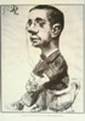 Love is when the desire to be desired takes you so badly
that you feel you could die of it.
HENRI de TOULOUSE LAUTREC
Friday June 27th, 2008
Civilisation (970 words)
For those of you unfamiliar with the 19th century
Academy of art in Paris, it represented, for good or ill, the direct
evolution from cinquecento (16th century) Renaissance into the art of
the modern, post-industrial, era. When I say “For good or
ill” I mean to say that just because it was a direct evolution
does not necessarily mean it embodied improvement as consequence.
By the 1860’s there were so many rules to
describe & quantify the acceptable way to symbolize beauty in the
visual arts that they had effectively removed art's pre-requisite
margin required for originality & spontaneity; which resulted in
paintings being done by painters all over Europe that were
indistinguishable from one another but for the signature.
Then, suddenly a wild revolution began in the late
1860’s where all that long tradition was put in question. Why?
Why did the Impressionists *
appear so abrubtly & after so many years of accepted tradition? (In
little more than ten years the Impressionist movement killed &
replaced its four/five hundred year old ancestry **).
Well, there were many elements that came together at that moment in
history, from the redistribution of wealth the Industrial Revolution
had brought, to the well-known effect on composition & subject
matter the invention of the camera revealed to painters.
Then the lesser-known but equally important inventions
like the folding (portable) easel, or lead tube with screw-top for
storing paint that replaced the animal bladder with ivory stopper, that
could not be used outdoors because the paint dried too quickly (forcing
painters to do their formulized landscapes indoors from sketches done
outdoors instead of plein air painting where the canvas is taken to the subject for direct observation).
The young artists whose experiments eventually gelled
into the school of painting defined today as Impressionism, were tired
of the limitations of the rule-heavy French Academy & jumped at,
among other things, the new aesthetic introduced with the first
Ukyo-é woodblock prints that arrived from Japan mid-nineteenth
century (some say they were first introduced as wrappers for fruit
imported from Japan just as we in Europe might wrap fish with old
newspaper) & Chevreul’s new colour theory (published while he
was employed by the paint company Lefranc Bourgeois, still
making paint today) as represented by the common colour wheel familiar
to any high school student today. To realising the expressive qualities
of the new 'visible brushstroke' in the canvasses of Impressionism's
precursors like Manet, Courbet (a master of the palette knife like no
other) & Delacoix.
Since glazing with translucent layers of paint was
impractical out-of-doors because of its long drying time, shadows, for
the first time since Paulo Ucello, turned opaque. I could list dozens
of other details that were as important but put together:
Impressionism's 'sudden' appearance becomes less mysterious.
Throughout the last half of the 19th century there was
one man, Ruskin, who had an unprecedented, & unrepeated since, sway
on public opinion in all questions of aesthetics though he worked as an
art critic. Ruskin's writings were copious & if a little
grandiloquent, when read within the context of the Victorian style, one
recognizes what a very good & original writer he was. During the
long trial between him & the American artist working in London-
Whistler ***, he also showed himself to be up to Whistler’s own high standard for spontaneous wit.
History, however, has shown that despite his powers
& general acclaim he backed the loser, defending the French Academy
vision even after the Salon de refusés (gallery of
rejects, i.e. the exhibition mounted by the artists whose work had been
refused by the all-important annual Academy exhibit without whose
début it was difficult for an artist to find credibility with
the painting buying public) had become the more popular venue.
Amazing how a full career that shaped the taste of two
generations of Europeans & Americans could, twenty years after his
death & ever since, be recognised as having been exactly &
unmitigatedly wrong.
He did, never-the-less, write some things that are still worth reading, like this:
“A
civilisation is written in three manuscripts, that of its deeds, that
of its thoughts & that of its art. One cannot understand any
culture by reading any two of these manuscripts; one must read all
three but, of course, always remembering that the only true one is the
last”
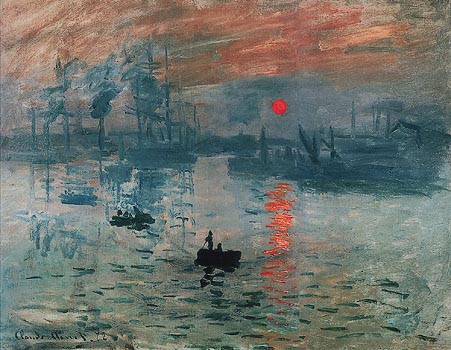
* The movement’s title was misappropriated from the 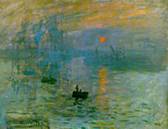 critic Louis Leroy who referred to Monet’s painting Impression, soleil levant- ‘Impression of sunrise’ (exhibited in the Salon de Refusés) in a denigrating critique as ‘Impressionism’ Return...
** One might
say: like the huge jump similar to that of thousands of years of the
horse being replaced in 50 by the car, so Picasso's Dad (Jose Ruiz
Blasco) had a successful career as Victorian painter doing sentimental
still lifes of pigeons while his son did things so original that he is
the only reason Picasso senior is remembered at all. Return...
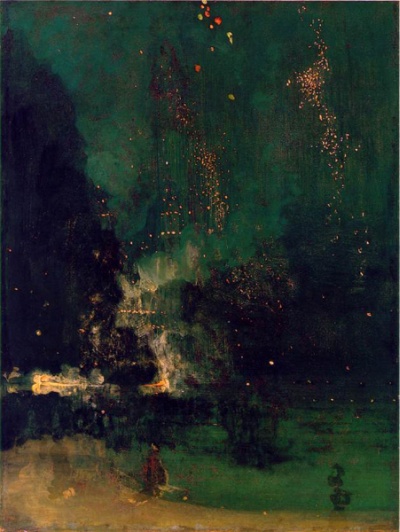
*** I have read
the court transcripts in book form. The plaintiff was Whistler who
brought suit for an article published by Ruskin calling
Whistler’s little impressionistic canvas (actually: board) of
fireworks over the Thames: “A pot of paint thrown in the face of
the art-loving public” The argument & repartee of each day's
session in court were read avidly in the evening papers by all the
classes in London for the months the trial lasted.
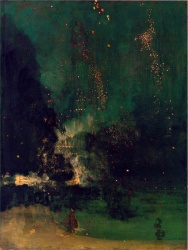
Its outcome? The judge found for Whistler but named
the damages as a symbolic penny, to be paid by Ruskin to Whistler.
Unfortunately for Whistler who was a flamboyant, elegant man who tended
to excess, he was left at the conclusion of the trial, in possession of
nothing but that penny since the trial's expenses had reduced him to
bankruptcy. Return...
Comments
Wednesday June 25th, 2008
Martial Art as Sport (1090 words)
I was visiting an old friend the other day in Marbella
who, as we talked & shared a bottle of wine, brought up a video on
his huge computer screen. My friend, Pistola, is a bit of a brute
because of the circumstances of his tough life & his naturally
strong build (I'd kill for Charlton Heston shoulders like his!), but he
has a woman's heart due to his genetic make-up & the combination
has inspired in me a deep fondness for him that has endured these many
years despite our fundamental differences.
The video was about half an hour long & was a
medley of the best moments of a fighting sport. It was so repugnant I
would not have watched the whole thing if it weren't for the fact
Pistola kept pausing & restarting it along with our conversation,
occasionally, excitedly pointing out a particularly atrocious moment.
The fighters were very well trained, extremely strong
& intelligent martial artists, their speed & range of reaction
(taken from disciplines as diverse as Muey Thai, Jiu Jitsu, Boxing
& Karate) made fascinating interaction, like a beautifully
choreographed Jet Li sequence, not a free-for-all, ear-biting,
hair-pulling, street fight.
In my travels I have sometimes found myself in dodgy
circumstance & have had opportunity to see real & savage
violence where someone is cut badly with broken bottle, cut bare with
knife, or maimed for life by kicks offered after the opponent is lying
on the ground, unconscious.
I have also done my share of fighting & the fact I
never suffered worse than a lost tooth, black eyes or bruised ribs --
even my big nose maintains still its enviably aristocratic &
masculine bridge (if I look left or right my view is blocked to one eye
by my nose's presence!) -- it has been just sheer luck & not
because of my inability to find opponents capable of far worse.
The bouts Pistola showed me*,
never-the-less, were so uncommonly brutal that I am very sorry indeed
to have added them to my brain's, image data-base; because they are
haunting me yet.
The combatants wear very thin boxing gloves designed
more to protect the knuckles than what the knuckles come in contact
with, small shorts (though unlike under the Queensbury rules, hitting
below the belt or, for that matter, concentrating one's attack on a
vulnerable opponent's future ability to procreate, is perfectly
acceptable). The only rule is that you stop hurting the other guy when
the referee tells you to.
Despite the existence of this rule two images come to
mind, one of a man having his back broken by repeated & lightning
fast blows of an elbow- to all appearances as hard, fast & deadly
as a compressed air, pile-driver -to the upper spine of an already
unconscious fighter. The other was also unconscious before having his
nose pushed deep into his face by several blows of a forearm trained to
rock hardness.
It is not at all unusual that these young men, genuine athletes at the top of physical form, die during these combats.
Since the images have, as I said, been haunting me
since seeing them I have also been thinking about the why of it &
trying to define my reaction to myself, why, for instance, can I watch
a bull killed in the ring quite happily but not two men trying to kill
each other? Is it mere prejudice as member of the species? The death of
the bull-mammal distant enough to me from the death of a human-mammal
that I don't feel or empathize with it in the same way? (As a living
thing with a similar attachment to its life, to a continuance of being
alive, as I have for mine).
But no, I am glad to find my reaction is not so
superficial: in concept I am not against the sport. The combatants are
fully aware of the risks & of an age responsible for their own
decisions. All sportsmen take a certain risk with their old age in
exchange for youthful success (most careers' success depend instead on
years of hard work for achievement in middle-age) even those sportsmen
who aren't required to accept being hit over & over again in the
face & head **.
If these young men have decided to accept the
possibility of death or disability in order to have a shot at a success
their lives may offer few other options for, well, I think it is their
right just as it is their life.
And within an environment of acknowledged risk even the
excessive brutality like that I described above (continuing to hurt an
opponent already vanquished) can be acceptable within the rules of the
game. The fighter who projects an image of an inhuman savagery achieves
a psychological advantage over his next challenger equal in value to
his experience, his size, his fighting knowledge, his speed...
So why do I reject it? Not want to see more? (Despite
the undeniable morbid fascination- 'morbid' is, after all, bad by
definition) I decided it is because though I recognize their right to
fight & respect their dedication as I might any trained athlete, I
think that as a member of society I do not want to be among those that
turn such barbarity (as in the opposite of the loose social pact we
refer to as 'civilisation') into an acceptable entertainment by being a
member of its audience.
I would even go a step further & say it is not the
terrible physical harm inflicted or risked, that defines it as barbaric
to me; nor either the context of it being a spectator sport (i.e. in
the category of entertainment) but rather the inhumanity as defined by
the pre-requisite lack of essential sympathy between humans necessary
to pursue competition in such a sport.
*
I am purposefully avoiding mention of the sport's name as I don't want
any responsibility, however small, for its popularization. Return...
**
George Foreman's manager, who stopped a fight with Muhammad Alí
in the 14th round giving Alí a technical knockout & the
championship belt- for fear his valiant fighter might be killed
otherwise- said as rationale: "Death has no place in sport." Although I
don't actually agree in concept (When a marathon runner falls over dead
of a heart attack or dehydration, a skier breaks a leg or a
steeplechase rider, his neck- no-one says they shouldn't have been
allowed to compete) but I think his priorities charming! Return..
Monday June 23rd, 2008
I'm a rattlesnakin' Daddy, I'm a rattlesnakin' Daddy, & my snake wanna
rattle all the time
I woke up at half past three this mornin' an' my
rattlesnake wanna rattle; I woke up at helf past four & he wanna
rattle all over again'
My rattlesnakin' Daddy wanna rattle in the mornin', my rattlesnakin' Daddy wanna rattle all night long
My rattlesnakin' Daddy'l rattle to the left; my rattlesnakin' Daddy'l rattle to the right
My woman say my rattlesnakin' Daddy wanna rattle all night,
An' that woman- don't never let that rattlesnake outta her sight...
BLIND BOY FULLER, (excerpt)
Wednesday June 18th, 2008
Becoming an artist (an excerpt from a letter I received asking how one changes careers to become a painter, & my answer below- 710 words)
I've been a truck driver since
1994 with other jobs like insurance sales, security guard, postal
service, food service & others before that.
I was surprised recently when career testing indicated I rank in the
91st to 98th percentile compared to others in music, performing arts
and other arts, sculpting, writing, and social sciences.
I'm just presently interested in breaking into the art field to earn a
living until I can eventually hopefully become a painter, sketcher or
possibly even a sculptor.
Since I have no experience in the above, are there still any ways I
could find employment & earn a decent income in the music or arts
industry without having to actually be an experienced singer, composer,
painter, sketcher, or sculptor?
I like to travel too and wouldn't mind travelling for a company
buying/grading art or helping a company with other facets of their art
business. I guess I might compare this to a gemnologist travelling
around the world buying certain quality/grades of preciuos stones for
their employer. I would have an interest in learning fine art and
sketch artist's names, styles and eras.
Do any companies possibly offer internships to persons with my interests?
If you could relate any other employment possibilities I might qualify
for in the field of art without having to presently be an artist, I
sure would appreciate it.
Thank you very much.
Answer: Interesting Joe (name changed), but I think you are asking the
wrong questions. The visual arts market is of those with a huge
excess-of-talent to market-demand ratio.
First: if you want to make a living painting, drawing or sculpting,
before you begin the long, arduous & disciplined training you will
need in order to compete with those already ahead of you, you will have
to decide (as unavoidable pre-requisite) that you want to do so out of
an abiding love of the subject- & not because the test you took
says you have the potential to learn to express yourself creatively
(if, indeed, that is what the test tried to establish) otherwise you
will never find the stamina to make it to the end of the road.
Second: If you decide you are driven by a sustainable desire whose
motivation will not flag through the years of 80 hour weeks it will
take you to catch up to those of your age who have already done that
part, then it will not be a question of learning how first, but rather:
why?
Along with the simple exercise of learning to represent what you see on
canvas, paper or with sculpture, you will have to look -& learn
what it is about art that you like. By this I don't mean just
choosing an artist or style but coming to the deeper understanding of
why this particular artist or style speaks to you. Without this
guiding light in your inner vision anything you learn to do will not be
a unique expression of 'JOE'.
Once you have learned why you think art is great & are familiar
with its luminaries over the centuries, their styles & how to
define them, you can at least get a job like taking care of a gallery
that can pay for the hours you will need to practice as well as
acquainting you with the society & its vocabulary. But any
serious gallery will fire you if they notice their clients know more
than you. A job as guard in an art museum will at least give you an
environment that lets you study great paintings while earning a living.
Internships come after study but if you mean
apprenticeship then yes, here in Europe you can still find places to
learn while apprenticing but the work is hard & poor & the
training slow- recommended really only to the very young.
The surest & easiest path to earning a living in the world of
visual arts is the few years it takes to become a teacher. The school
you go to will teach you how to pass the exams they set in order to get
the piece of paper which they themselves need on file in order to hire
you to teach young people how to become the artist you (the teacher)
did not...
That same hypothetical school, incidentally, will be
the only example in the wide world of art who will consider your
diploma proof of your being an artist much less decide to pay you as
one because of it. Funny old world, isn't it?!
Are you sure you still want to spend the rest of your
life pursuing the elusive masterpiece that will validate your
commitment? No crazier, I suppose, than the many theoretical physicists
who dedicate an entire career to the first 32nd part of the first
second after the Big Bang!
I have no doubt the most valuable piece of advice I can
give to anyone serious about commencing on a road like this one is:
work from life, not photographs & certainly without any aids like
projectors. Leonardo said: "God creates, man translates" it will be in
the mistakes when translating from three dimensions to two, where you
will find 'art' slipping in almost as if by accident; otherwise all you
will ever learn is how to copy from 2 dimensions to 2.
The reason this is not true of sculpture, where one
interprets in 3 dimensions from 3 dimensions, can be found in Rodin's
definition of sculpture as: "An infinite number of silhouettes" &
there is always room for interpretation within infinity...
My deepest respect & best wishes if you find it in yourself to tackle the challenge.
Sincerely,
Paul
Thursday June 12th, 2008
Insomniac notes (280 words)
At thirteen I discovered Hermann Hesse. He opened my
eyes to a world of thought I had no idea existed & I devoured his
life work before reaching fourteen.
Without knowing where to go next I reached for Huxley,
Aldous—not yet the other brilliant members of his gene
pool—& I enjoyed him thoroughly though he was as mere fluff
compared to Hesse. I digested his life’s thoughts even more
rapidly
when… in walked Nietzsche. Catching me unawares he grabbed me by
the throat & as he repeatedly & with great violence slapped my
brain, he explained in that poetic high German of his—which we
translate to Elizabethan English: Forget thou that soppy nonsense ye
worthless puddle of infirm rat bile—be a man & face the truth!
I listened, more than a little shaken, & by fifteen
had decided that truth, both beautiful & profoundly alarming, was
paradox, pluralism, antithetical compatibility; absurdity: truth was
falsehood, all was true, all was false, all was both true & false.
But just as one can fall in love, fall from grace, fall
asleep or fall ill, falling itself isn't good or bad: all has intrinsic
good & bad, pleasure & pain. And so with insomnia—a curse that
must make narcolepsy seem a pleasure. Time takes on a palpitating &
arrhythmic quality where I can hardly tell the chronology of my own
thoughts. But it too can—when aided by a brain addled by sleep
deprivation while lying in a very hot bath; Chet Baker’s voice
complaining of heroin & heroines as it wafts on the silent darkness
of early pre dawn—offer refined & subtle pleasures.
Wednesday June 11th, 2008
This compilation of thoughts, dialogue & stories called: Paul's Mental Workshop, is 2 years & 1 day old today! About 70 entries in 60 or 70,000 words...
If the mind were simple enough to understand
it would be too simple to understand (600 words)
This is a quote by a neurologist I read
whose name I can't remember to give attribution (sorry old boy, because
it is a good one!)
I think it is inevitable that we, we pathetic Homo
Sapiens, with our pretensions of intelligence & objectivity, have
an innate & unavoidable belief in a dichotomy which is an illusion
that has no basis in truth: that of the mind & brain. We look at
how the brain works with our minds- what absurd stupidity! Their is
only the brain & its processes which we, with great hubris, call
intelligence.
These thoughts have nothing to do with metaphysics,
with soul or even a collective unconscious, but rather the simple &
uniquely undeniable experience of life I who write, & you who read,
share.
I can remember an age when I was fully aware that I was an example of
the male of my species while my sister was a female & I can also
remember clearly that at that age, the fact had no significance
whatever: no real meaning.
I remember likewise, at around the traditional age of self-awareness,
of recognition of unique consciousness- seven years old, understanding
I was I. It wasn’t until about three years later though, in a
moment that may have lasted only three seconds or perhaps- three
thousand years, it is difficult to judge, a REAL understanding that I
exist. I remember the place, the neon lights that illumined it, the
colour of the walls of the room where the event happened & the
mirror into which I looked as if it were now instead of nearly 40 years
ago.
Perhaps strangely, it was sometime between these two moments that I
realised what death was, that I would one day become extinct. It was a
terrible moment which my mother, with an empathy typical of her but an
inability to explain or indeed, to offer words of any kind,
never-the-less was
able to offer the deep comfort of her embrace until my desperate tears
eventually turned to exhausted sleep. Since that night the
contemplation of the fact has become to my mind as a sore in my mouth
is to my tongue: a pain so attractive in its repugnance that my mind,
like my tongue, cannot leave it alone.
Einstein said: “Death is nothing, why would one fear
nothing?” Well, I won’t offend the reader by enumerating or
quantifying the advantages of something over nothing but his simple
phrase holds a deeper truth about human psychology which my ruminations
have decided include the false sense of dichotomy I began this essay
with, i.e. it is nearly impossible for us to imagine our own extinction
without ourselves as witness to it.
The mind seeing the brain die is, without question, an
abhorrent thought. Whereas, given only a brain & no mind, the
thought of not existing after we have existed should be as easy as the
ease with which we accept not existing before existing. No brain in the
history of self-awareness has bothered itself with anguish at the
thought there was a time in the past it didn’t exist but many,
like mine, feel a terrible angst at the thought of not existing in the
future… (the irrational inferrence being: the mind witnesses our
death but wasn't there before our birth)
I suppose the real wise man is Charlie Musslewhite, not Einstein, who in one of his fine songs said:
Don't worry about losing your mind just don't lose your keys.
 Come on Cholita, let's go down to Cuba
  & make some memories that will enrich our hearts for as long as we live...
Sunday June 8th, 2008
Age (380 words)
A couple of days ago I discovered a very nice little
café in town owned by an old woman who has bought the ancient
building & is in the process of restoring it tastefully into the
café which she has finished, as well as five hotel rooms &
restaurant to come. I was there to meet a friend, a painter from
Madrid, & since I got there early & was the only one there, I
quickly made friends with the old woman who ran the place.
After a nice conversation & a few glasses of fine local Fino (sherry) with my friend, 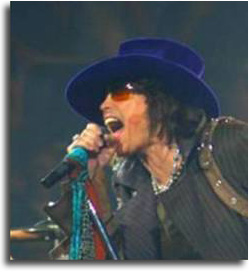 we
were on our way out when I noticed a cork-board in the hall outside the
entrance covered in images of a young Bob Dylan, Led Zeppelin, Steve
Tyler from Aerosmith & the like. As my friend said his good-byes to
Laura, our hostess, I looked at the pictures & Laura noticed,
commenting: “I see you like the same music I do” When in
fact what I had been wondering is what this old woman was doing
interested in such things instead of Frank Sinatra & Pat Boone! It
was then, of course, I realized she was probably only just a little
older than me...
we
were on our way out when I noticed a cork-board in the hall outside the
entrance covered in images of a young Bob Dylan, Led Zeppelin, Steve
Tyler from Aerosmith & the like. As my friend said his good-byes to
Laura, our hostess, I looked at the pictures & Laura noticed,
commenting: “I see you like the same music I do” When in
fact what I had been wondering is what this old woman was doing
interested in such things instead of Frank Sinatra & Pat Boone! It
was then, of course, I realized she was probably only just a little
older than me...
By the same token a very handsome & nice young man came over with a
business proposition for me the other day & as we got to know each
other I told him my father was a Scot the same as his & I took him
into my office (where I am now writing these thoughts) & showed him
a photo I have of my Dad playing the bagpipes. When he noticed my
Dad’s broken nose I mentioned he had been British Flyweight
champion boxer & that the young man’s, Sam’s, father
would probably remember him. When Sam answered with a blank look I
remembered I was the age of Sam’s father & it would be his grandfather that would remember my Dad!
I just can’t seem to get used to being 40 years old & I
haven’t been forty for 6 years! But I’ll tell you young
folk out there something you have to look forward to: excepting the
body’s deterioration everything else about getting old is great!
Saturday June 7th, 2008
José Tomás, the bullfighter (220 words)
Link to a page with 6 good images of Tomás fighting
Yesterday, José Tomás was carried through
'la puerta grande' (the big door) from Madrid's bullfighting ring on
his fan's shoulders. He cut four ears & a tail, an achievement not
matched since Manolete did it in 1930. The audience of 24,000 shouted
deliriously with one voice the simple compliment: "Torero, torero,
torero" as if there had never been another worthy of the title.
With his heavy-lidded metaphor of masculinity he showed
the Cordobés' kneeling in front of the bulls' horns for what it
is- mere circus act, & 40 million Spanish hearts added a few beats
a minute in his honour.
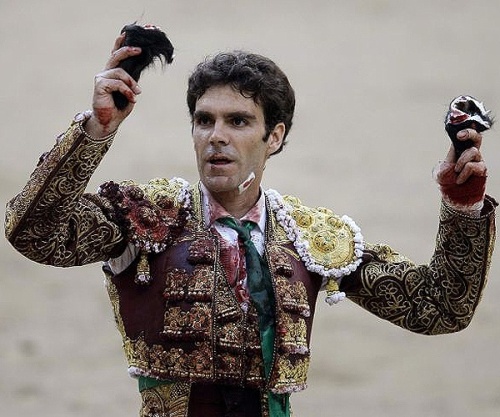
I would go further than the excited newscaster, who
reported the event on yesterday's news-- leaning into the camera, eyes
wide-- he is not as the newscaster pointed out, a man with "cojones"
but rather balls that happen incidentally, to have a man attached.
The way they compliment his bravery here is not by calling him fearless but with: "He shows fear disrespect"
Hats off & a heartfelt toast to José Tomás: a man.
---
Caught
by the bull in Barcelona's (Linares) arena in June 2007 he ties a
necktie around his thigh as tourniquet & goes on to kill the beast
(1 minute on YouTube)
The kill, one minute from yesterday's toreo in Madrid on YouTube
Saturday June 7th, 2008
"What's wrong Cap?"
"Well, Baldrick, many things are wrong: to start with
the mere fact I am not rich & powerful with the sexual vigour of a
Rhinocerous niggles at me every day."
Rowan Atkinson as Captain Blackadder (in the last season of Black Adder)
Thursday June 5th, 2008
This is not a Blog! (590 words) definition of 'blog' from wikipedia
I have a friend, Joe Lane, with whom I have shared a
common interest in conversation for about twenty years now who,
never-the-less, has such deep & abiding prejudice for blogs he
refuses on principle to read mine though I have tested his prejudice by
tricking him with an article from my blog in the form of letter to him
he then reacts to with the interest I am accustomed to in our
conversations.
The attitude to blogs expressed by the author Ursula K Le Guin in an article for Harper's
(February 08) about the decline in book readership with the advent of
the Internet: "You can look at pictures or listen to music or read a
poem or a book on your computer, but these artefacts are made
accessible by the Web, not created by it & not intrinsic to it.
Perhaps blogging is an effort to bring creativity to networking, &
perhaps blogs will develop aesthetic form, but they certainly haven't
done it yet." are very easy to find while the opposite, opinions
supporting their value, are very rare indeed.
I both agree & disagree, yes, the majority of blogs
are mere manifestations of ego & few are egos that are as
interesting as they themselves seem to think. However, there are also
blogs that consist of interchange between the world's leading
theoretical physicists, or discussions of philosophy, or art by great
authors & leading university professors.
Despite having discovered some of these fascinating blogs*,
where I could spend large chunks of my time reading & learning
about things I am interested in from people who know more about them
than I, I often resist the temptation for the same reason I don't watch
television: my curiosity is broad & my life short. I could easily
fall victim to 'analysis paralysis', where the quantity of information
I must process & assimilate becomes larger than the time within
which I have to do it.
If I don't remind myself I am a painter with strange
curiosities I run the risk of becoming instead, a mere collection of
strange curiosities...
My point being that despite their bad rap, the
percentage of great & valid blogs is probably similar to that of
great books among the heaps of nonsense we are used to as readers of
paper instead of electrons on a screen (i.e. more than one paltry
life-time allows us time to read).
What is my motivation for keeping a blog? Well, it has
been a format I have been grateful for because it provides me a
motivation, or perhaps more accurately: an excuse, to write the essays
that allow me to verbalize & crystallize my thoughts; which
exercise I have always loved anyway but before blogs- used to write on
paper & throw away afterwards. The other attraction the blog offers
is because it is so much easier to publish than paper it allows me to
receive feedback for these thoughts no-one would read otherwise.
And so I resent having my blog lumped in with the ones
filled with glittering pictures of angels & fascinating talk of
what the blog's author had for lunch, while regretting that the very
category excludes the interest of interesting people like my old buddy
Joe.
Considering this dilemma has led me to the brilliant
solution, not of quitting, but of changing its name. I declare
therefore- henceforth this is NO LONGER A BLOG but rather: Paul's
Mental Workshop!
* For example- Edge.org or ted.com Return...
TOP
page 4
Mental Workshop- pg 1 | pg 2 | pg 3 | pg 4 | pg 5 | pg 6 | pg 7 | pg 8 | pg 9 |
<previous |
next>
Links to post titles:
P'sMW- page 1
Four ducks | A painter's style | Thinking with Google | The Vulture's Throat | Tortures of the
Damned | Memory and self | Hinduism and me | The Barber | Glasgow Smile | Airports | False advertising | Buttons | Govandhan pooja | Mean Streets | Population | Back in New Delhi | Buskers | Science and Philosophy | Happiness and Theory of
the Mind |
Boat races in Sarasota | Would
you
kill yourself to go on living? | More Happiness | Theo Jansen's kinetic
sculpture |
ebooks
and writers | Arthur Ganson | Thai politics | Misanthropy | Dying | Googling our minds | Knowledge transfer |
TEDTalks | Viggo | A study in ideal form | Fables | The Ant and the
Grasshopper | Conceptual Art |
The importance of
punctuation | California, first impressions | India | Conspiracy theories |
I love you; thanks’; you’re welcome | Errata | Fear | Egon & the other animals | A note about price:size ratio in paintings | Strange tales |
P'sMW- page 2
Christ’s devil | Timelines | Life's funnel | Souvenirs | Moon Myth | How chaos was subdued in the Japanese genesis myth | Noah Lukeman & the murky world of today’s book publishing | Morality and religion | Music and Love |
Temeris Mortis | The Dream | Peace | God's Tick | Old Man (short story) | Intuition | A Curious Fact |
P'sMW- page 3
Why Humans prefer other Humans to be like themselves | A letter to painters | Why do people talk? |
The Painter's Eye | I'bn al Alhí's treasure (short story) | Associative Personality Disorder |
Love poems, death poems | The Golem | Elitism in Art | Theory of the Mind | Death Scenes | Politics II |
Rock & Roll | Words II- more words | Words |
P'MW- page 4
Confidence | How to steal from gullible artists | Priests behaving badly | How to make a painting | Oats & history |
A note about signatures on paintings | Bob Dylan | Number of atheists among scientists | Theoretical physics & me |
Faust & Mephistopheles | Children's reading habits | How to get good photos of firework | The 20th century |
Further Dialogue on the 20th Century article (here) with comments by Bobby Porter | Love is | Civilisation |
Martial Art as Sport | Blind Boy Fuller | Becoming an artist | Insomniac notes | Mind-brain | Age | José Tomás |
Black Adder | This is not a Blog |
P'sMW- page 5
Dammit! (final comments on the article Karma without metaphysics) | Laic morality (comments on Karma without Metaphysics) | Karma without metaphysics | Chivalric ethics | Shibumi | Shibumi: Comments by Bobby Porter |
Oxford Project revisited | How to travel | How Wang-Fô was saved | Fish memory |
The artist’s relationship to his work | Bobby's response to The artist’s relationship to his work | Egon | 20,000+ |
Memories of my father II |
P'sMW- page 6
Men & Women | Girls: come closer & I'll tell you a secret about men | Catholic Spain | Art is | Bad luck |
Dogs are the Best People | Tough Love | Dense, intense and condensed: a short
love story |
Cubans, Norwegians & me | From the Guggenheim to Santiago's tomb | Memories of my Father | Ecco il uomo |
Divorce & maturity | Inspiration & process | Bulls & men |
P'sMW- page 7
Truth & beauty | Bugs as food | What is art? part II- Is modern art, art? |
A painter’s thoughts about self-portraits | The Piraha of the Amazon jungle | Thailand: stories |
P'sMW- page 8
We'd be better off without Religion | East Meets West | Thoughts on Memory | Scared | Frank Zappa |
Art & Dreams by Ilene Skeen | Indoctrination | Rush to change names in Isaan | The Artist & Emotion |
The art critic | What is Art? Part I | Note of introduction added to the Masculine/feminine article |
Rebuttal to Raymond S Kraft |
P'sMW- page 9
I'm back! | Masculine versus feminine, Muslim versus Buddhist | Driving with Muslims or Buddhists |
Peter Feldstein & Stephen G Bloom's Oxford project | How to
argue | On 'happiness', in answer to Ivan's comment |
Thoughts on Happiness | The birth of Chiang Mai | War
Story | Happiness Versus Suffering |
Cogitations upon observing the life of an ant, from its birth to
its death by old age, while I lay in a bathtub.
June 10, 06
TOP